
As early as 18,500 years ago, the Americas’ first peoples spread south from Beringia but how.
An international team of researchers has found evidence that suggests the Ice-Free Corridor (IFC) proposed to have existed between ice sheets along a route from Beringia to the Great Plains came to exist approximately 13,800 years ago. In their paper, the group describes using cosmogenic nuclide surface exposure dating to date boulders left behind by the ice sheets that once covered the IFC, and their conclusion that early travelers likely came by boat.
New data based on “cosmogenic nuclide surface exposure dating” suggests that a water route was more likely. I love that geeky sounding term for the dating even if it is essentially just counting neutrons.
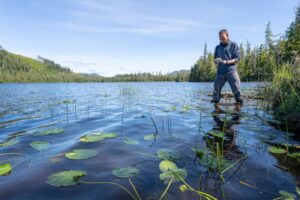
Another group thinks similarly and since Vancouver Island escaped the ice age that may have helped. The kicker is this claim.
The traditional stories of the Quatsino First Nation of northwestern Vancouver Island do tell of that earlier arrival. Quatsino hereditary chief Sonny Wallas (David Hanuse) says his people were in the area before the last ice age, and only survived it by going to Klaskino—an ancient village on the Brooks Peninsula about 50 kilometers southeast of Topknot Lake.
Wallas’s great-grandfather James Wallas—coauthor of Kwakiutl Legends—told him the story of how the Quatsino were warned by their protector, the thunderbird, that the ice was coming. “The thunderbird, back then, didn’t have good eyes, and the snail did have good eyes, so the thunderbird asked the snail if they could switch eyes,” Sonny Wallas says. “The thunderbird said, ‘I feel something bad is coming and I need to see.’”
That is pretty specific and quite a stretch of time to have a story that far back. I want a lot of proof before I buy that one.