For anglers, landing a muskellunge, or muskie, is a big deal. The “fish of 10,000 casts” is notoriously elusive, making the massive fish an even bigger prize when one finally strikes a lure. In a new study, University of Illinois researchers got into the minds of muskies to learn what personality traits make the fish more likely to strike. In the process, they learned valuable lessons that could help conserve the important aquatic predators.
“After 35 days throwing our whole arsenal at them, every combination of time of day, lure, and casting style, we can verify muskies are indeed the fish of 10,000 casts. We only caught seven fish. In addition, we saw that catch rates decline very, very rapidly after the first several days,” Bieber says. “It was a long month.”
“Why are muskies the fish of 10,000 casts? They’re sedentary and they hide, so you have to cast where they are. And we have anecdotal evidence that these fish seem to learn when anglers are around and actively avoid lures. And then there’s the historical context. Years ago, people would harvest muskies. If they were taking vulnerable fish out of the population, then you just have hard-to-catch fish left today. So, there are a bunch of things that potentially contribute,” Suski says.
Yes, it is. This report has some new data on that.
The great Roderick Haig-Brown had a comment on what makes a great sport fish to the effect of an interesting fish is a hard to catch fish. Muskies are famous for that. Their size, scarcity, looks and environment all help make them a quarry that people obsess over. Oddly, pike do not get quite the same reverence and I have never been sure why. I saw a decent pike once and landed a couple of hammer handles but never a muskie.
Muskies are ambush predators. Their long bodies are built for short bursts of speed.
The data reported in the article meshes well with other fish behavior. Atlantic salmon and steelhead anglers have theories that a small fraction of fish are taking fish. Remove those and it can get very slow indeed. When I fished sea run browns most often they would be under cover and you had to get the lure as close as possible on the first try to draw interest. They would follow it to shallow water and either hit or freak out when they touched bottom. It was like they woke from a trance and realized they were exposed. After they raced back to cover, nothing would get them to repeat their first performance. Sometimes another day would give a second round but often nothing worked. It sounds like muskies are similar.
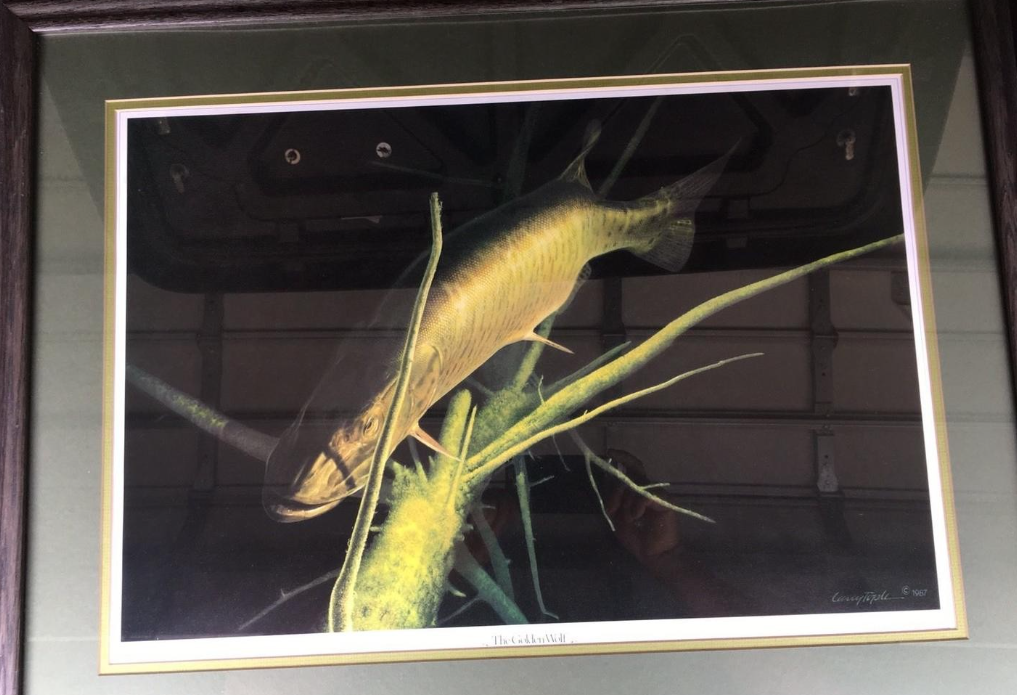
*I love images of muskies and muskie fishing but I seldom see a good one. Maybe the market is too small. The one above by Larry Tople is the best one I remember for getting the gist of a muskie. I like how it is on the border of light and dark where a muskie might linger. The drowned tree accents the association with cover. You can feel the brooding intensity of a predator coiled for action. It has the tropes of a fairy tale monster and for smaller fish it would be. There was another image that was also good but I couldn’t find it.
I was surprised that a good copy of “The Golden Wolf” image was hard to find. I had to settle for a poor version of the image.
As usual, open in new tabs to embiggen.
I have a parallel theory on turkeys; the vocal dummies have all been harvested, and we’re left with some very difficult birds.