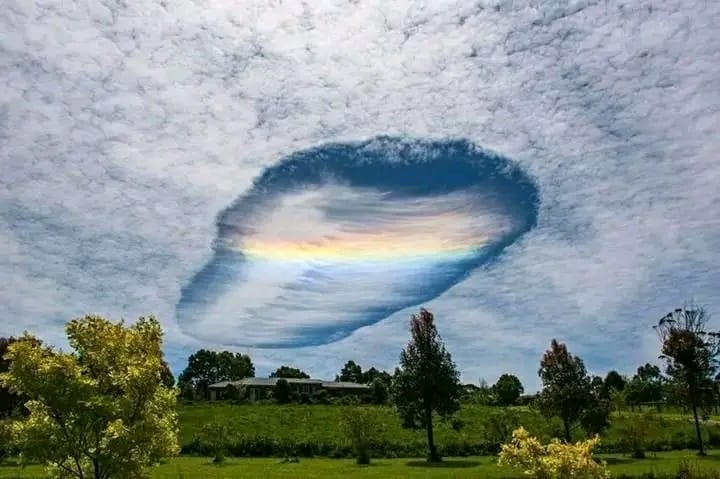
A fallstreak hole is a rare and spectacular weather phenomenon. The inhabitants of the state of Victoria (in the south-east of Australia) had the chance to observe one a few days ago. A fallstreak hole forms an oval or circular cutout in the layers of a cloud like cirrocumulus or altocumulus. Weather specialists believe that at some point part of the cirrocumulus or altocumulus cools. The water droplets in the cloud then go to a negative temperature (below zero). Instead of freezing these droplets remain liquid. (Physicists call this phenomenon, supercooling).
As they grow, these crystals gain in size and weight. At a certain stage, these frozen droplets are much heavier than the other droplets that surround them. They then fall below the cloud layer, evaporate quickly and leave a hole behind.
The superb rainbow that can be observed in the Gippsland formation is naturally the result of a refraction of the white light emitted by the Sun through the ice crystals persisting in the middle of the opening. When the light rays cross these frozen goulettes, the colors come out separated. SOURCE AND OTHER EXAMPLES.