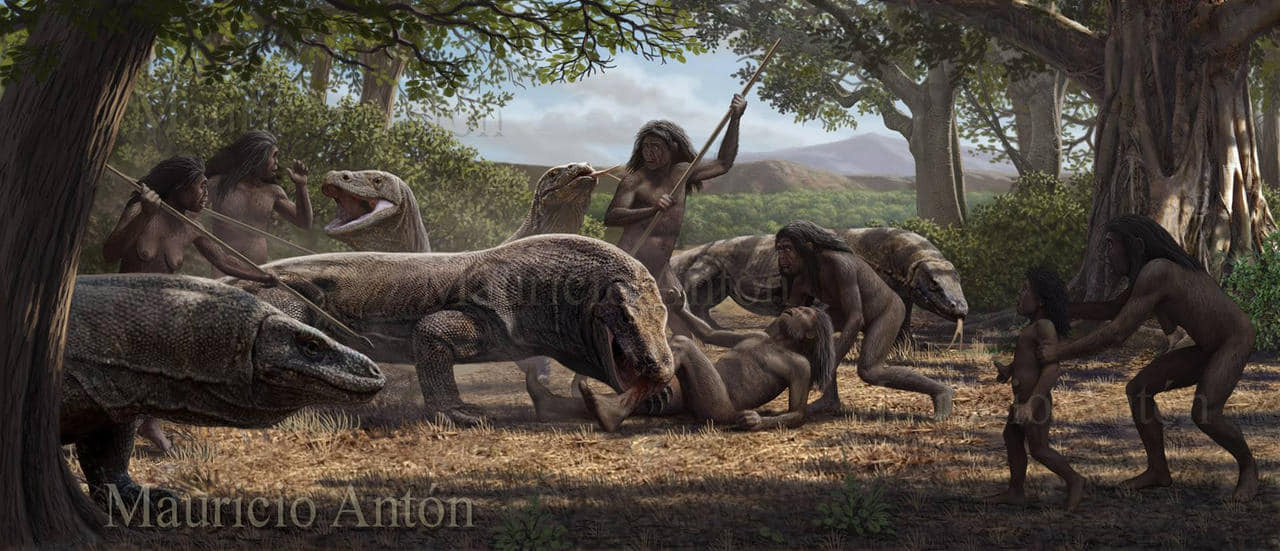
The first image is a spectacular illustration by the talented artist Mauricio Anton. Long ago in ancient southeast Asia, during the Pleistocene Epoch. A family of archaic humans, known as Homo floresiensis, are under attack by a mob of Komodo Dragons, Varanus komodoensis. The first remains of H. floresiensis were discovered in 2003 at Liang Bua cave by a joint Australian-Indonesian team of archaeologists on the small island of Flores, Indonesia. They stumbled on a largely complete skeleton with a skull and parts of at least nine other individuals. LB1 – the type specimen – was named and described by Peter Brown et al., in 2004. It consists of a fairly complete skull and partial skeleton, including leg bones, parts of the pelvis, hands and feet, and some other fragments. It is assumed to belong to a female aged about 30 years old and has been nicknamed “Little Lady of Flores” or “Flo.”
This skeletal material was first considered remarkable for its survival until relatively recent times, initially thought to be only 12,000 years ago. Thanks to more extensive stratigraphic and chronological work. We now know that H. floresiensis lived during the Quaternary Period, Pleistocene Epoch, Chibanian Age 100,000 – 60,000 years ago; stone tools recovered alongside the skeletal remains were from archaeological horizons ranging from 190,000 – 50,000 years ago. The name Homo is Latin for ‘human’ or ‘man’. The species name, floresiensis, recognises the island of Flores in Indonesia where the remains were found. Classified as Animalia, Chordata, Mammalia, Primates, Haplorhini, Simiiformes, Hominidae, Homininae, Hominini, and Homo. What’s most fascinating about H. floresiensis is their size. The holotype specimen (LB1) stood 1.06 meters (3 feet 6 inches) tall, had a brain volume of about 380 – 420 cubic centimeters, and weighed about 25 kilograms (55 lbs).
A second skeleton, LB8, has been estimated at 1.09 meters (3 feet 7 inches) based on tibial length. Their short stature was likely due to insular dwarfism, where size decreases as a response to fewer resources in an island ecosystem. Due to their small size and large feet, their discoverers quickly nicknamed them “the hobbits” after the fictional race popularized in J. R. R. Tolkien’s book The Hobbit and some of the discoverers suggested naming the species H. hobbitus. H. floresiensis bone remains in the cave date to 60,000 years ago, and the youngest stone tools to 50,000 years ago. Coinciding when modern humans reached the area, suggesting that the initial encounter caused or contributed to their extinction. This would be consistent with the disappearance of H. neanderthalensis from Europe about 40,000 years ago, within 5,000 years after the arrival of modern humans there, and other anthropogenic extinctions. The second image shows the skeleton of LB1, type specimen for Homo floresiensis, stored in the University of Wollongong, located in Wollongong, New South Wales, Australia. Image credit: University of Wollongong. Joshua Rojas
Wow, times were hard when you had to deal with this threat every day.
It looks unrealistic but the reality back then was likely too real.