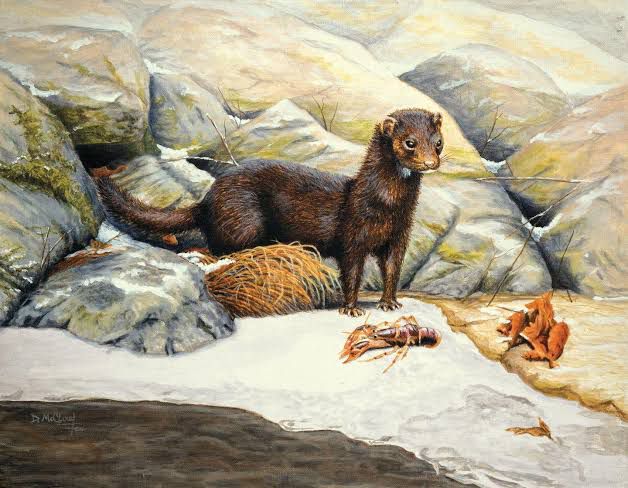
The sea mink (Neogale macrodon) – is a recently extinct species of mink that lived on the eastern coast of North America around the Gulf of Maine on the New England seaboard. It was most closely related to the American mink (Neogale vison), with continuing debate about whether or not the sea mink should be considered a subspecies of the American mink (as Neogale vison macrodon) or a species of its own. The main justification for a separate species designation is the size difference between the two minks, but other distinctions have been made, such as its redder fur. The only known remains are bone fragments unearthed in Native American shell middens. Its actual size is speculative, based largely on tooth remains. The sea mink was first described in 1903, after its extinction; information regarding its external appearance and habits stem from speculation and from accounts made by fur traders and Native Americans. It may have exhibited behavior similar to the American mink, in that it probably maintained home ranges, was polygynandrous, and had a similar diet, though more seaward-oriented. It was probably found on the New England coast and the Maritime Provinces, though its range may have stretched further south during the last glacial period. Conversely, its range may have been restricted solely to the New England coast, specifically the Gulf of Maine, or just to the nearby islands. The largest of the minks, the sea mink was more desirable to fur traders and became extinct in the late 19th or early 20th century. Art by: @WVDNR.
I think I first heard of sea mink in Wildlife in America by Peter Matthiessen.
Bob Hines was the artist for the book and one of the illustrations was of a sea mink. I have a clear memory of it even now.
I was in my early teens and it made a huge impression. Both the book and sea mink. They were local and that hit home. It was one of the first animals to disappear in North America.
Sea mink were gone before anything could be learned about them. It is not even clear what they were so little evidence is left. Hopefully, genetics can fill in some banks.
I do find it odd that their range seems so restricted. During the ice age they would have been pushed south into habitat much like the Gulf of St Lawrence yet they don’t seem to have made it around Nova Scotia. It is very strange. Newfounland would have replicated the Gulf of Maine habitat to a T. Endless questions and no answers.