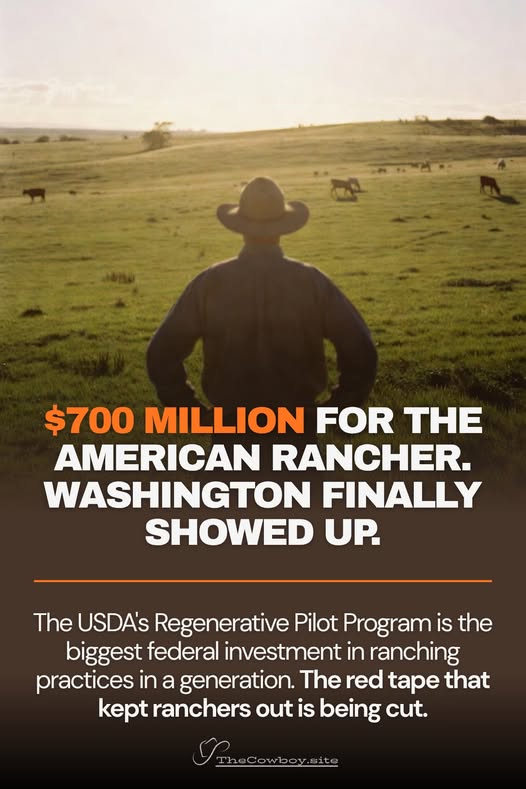
Washington wrote a $700 million check for the American rancher.
Not a bailout. Not a disaster payment assembled in a scramble after a hurricane. A proactive, structured, forward-looking investment in the way American ranchers manage their land — and a direct acknowledgment that the old system of conservation program red tape was costing the country more than it was saving.On December 10, 2025, USDA Secretary Brooke Rollins announced the Regenerative Pilot Program alongside the Secretary of Health and Human Services. The program commits $400 million through the Environmental Quality Incentives Program and $300 million through the Conservation Stewardship Program in its first year of funding. Farmers and ranchers interested in transitioning to regenerative practices can now submit a single application that covers multiple practices across their entire operation — a streamlined approach that replaces what had been a fragmented and burdensome multi-program process.The announcement was notable not just for the dollar amount but for what it represented about the trajectory of federal agricultural policy. Conservation programs at the USDA had grown increasingly complex over decades of legislative layering. Ranchers who wanted to adopt soil health practices found themselves navigating separate applications for separate programs with separate eligibility windows and separate reporting requirements. The complexity alone deterred participation. Data showed that 25 percent of American farmland acres had water-driven erosion concerns, and 16 percent had wind-driven erosion concerns — problems that regenerative practices can address, but only if producers can actually access the funding to adopt them.The new program collapses that complexity into a single entry point.A rancher in Nebraska who wants to implement rotational grazing, cover cropping, and water infiltration improvements no longer has to apply to three separate programs on three separate timelines. One application. One framework. One set of outcome targets to report against. The administrative burden that kept smaller operations from participating in conservation programs — operations that most need the financial support — is being systematically reduced.The program also expands access for beginning and new producers, a category the agricultural sector has identified as a critical pipeline for long-term land stewardship. Young ranchers who couldn’t build the documentation trail that older programs required now have an on-ramp specifically designed for their situation.Here is the moment that should reframe how this program looks from the outside: Regenerative ranching practices reduce reliance on purchased chemical herbicides, pesticides, and synthetic fertilizers — the same inputs that have driven farm production costs to historic highs. A rancher who transitions successfully to regenerative management becomes less exposed to the supply chain disruptions, tariff shocks, and price volatility that have pushed farm bankruptcies up 46 percent in two consecutive years. The program doesn’t just help the land. It builds financial resilience into the operation itself.Research from Oregon State University found that ranchers using regenerative practices reported something more fundamental than improved soil metrics. They reported improved adaptive capacity. Improved economic resilience. A self-reinforcing cycle where better land produced better forage which reduced feed costs which freed capital for further improvements. The land paid the rancher back.The $700 million commitment signals a policy shift that the ranching community has been asking for across multiple administrations: treat the rancher as a steward, not just a commodity producer. Pay for the ecosystem services that working ranches provide. Invest in the transition costs that keep operators from accessing better practices.The Regenerative Pilot Program is not a charity. It is a bet that the practices it funds will reduce the long-term cost of agricultural disasters, improve the productivity of American farmland, and keep more family operations economically viable through the financial shocks that keep arriving.The red tape that kept ranchers out is being cut. The question is how fast the ranching community can move to take advantage of it — and whether the funding will survive the next political cycle intact.Is the Regenerative Pilot Program the most significant federal investment in ranching in a generation — or just another program that looks better on paper than it works on the ground?

—Sources—USDA — Regenerative Pilot Program announcement, December 10, 2025Oregon State University / ScienceDaily — Regenerative ranching adaptive capacity studyAmerican Farm Bureau Federation — Farm bankruptcy data 2024–2025USDA NRCS — Erosion concern data and conservation program participation analysis
I don’t have background on this but it was a topic Steve was into at one time. Frankly with this administration I am skeptical given how they are trashing eco safeguards.