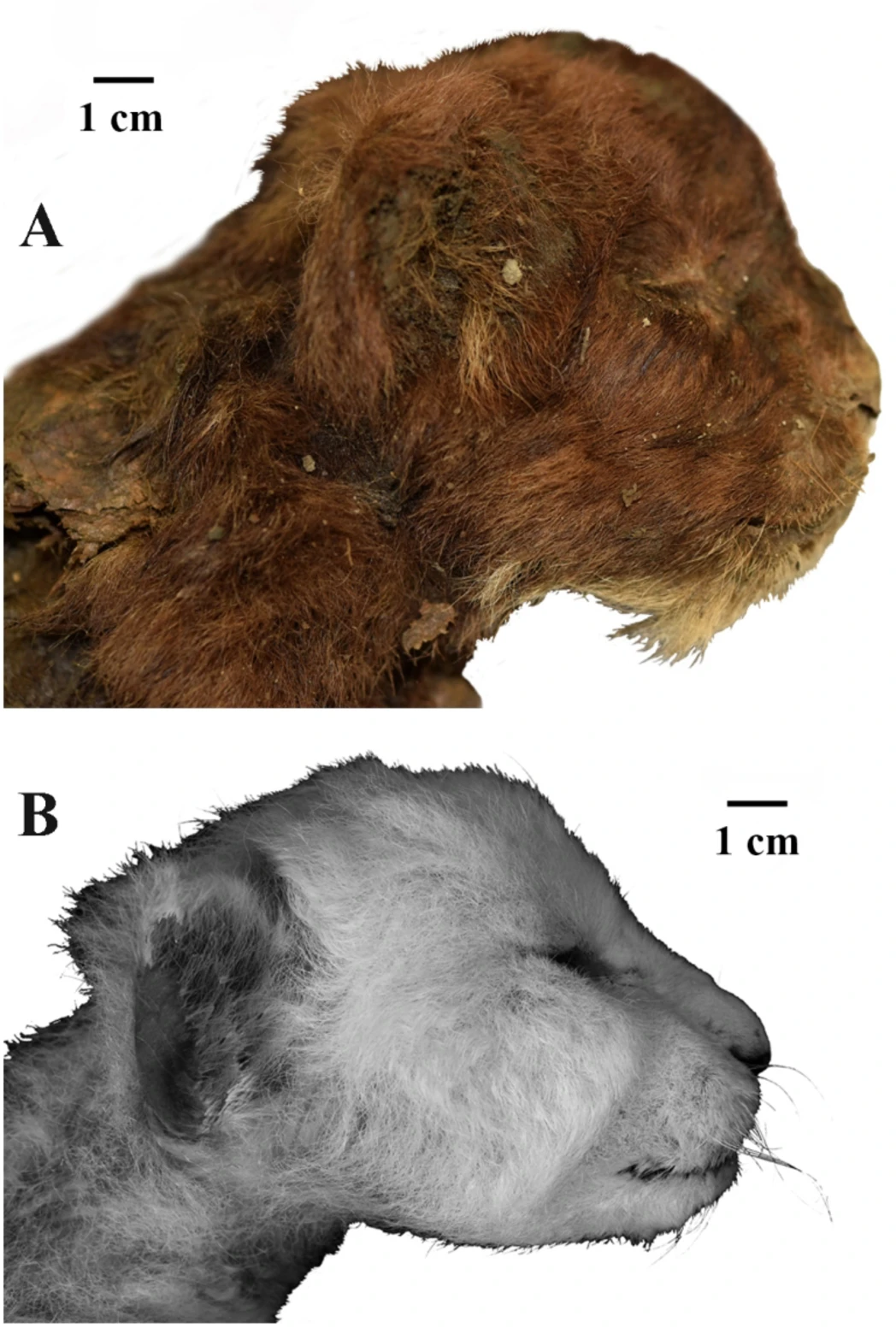
It’s one of the biggest discoveries of the century, and the first time humans have seen a Machairodontinae (Sabre-toothed/Scimitar-toothed cat) in the flesh (albeit mummified in permafrost) since their extinction some 14 – 10,000 ybp.
Mummy of a juvenile sabre-toothed cat Homotherium latidens from the Upper Pleistocene of Siberia
The Badyarikha cub is the latest in a list of Pleistocene animals recovered from Siberian permafrost, many of which have been announced in the media but not yet subjected to scientific study. In addition to woolly mammoths and woolly rhinos, they include wolves, brown bears and cave lions.
Several of the cub’s features are surprising and couldn’t have been predicted from previously known fossils. Long, pale tufts of hair extend backwards and downwards from the corners of the mouth, raising the possibility that these features were more accentuated in adults: perhaps they even had a beard-like extension covering part of the lower jaw.
Its paws are broad and the pads underneath each digit are square, rather than oval as is more typical in cats. The main pad underneath the palm is broad and kidney-shaped, and lacks the trilobed rear margin familiar in cats today, and a wrist pad typical of modern cats is lacking altogether. These paw details are all suggestive of heat conservation and imply that homotheres were specialised for walking in snow.
Of great interest is that the pelt is dark brown, with paler areas on the lower jaw and perhaps the paws. This might mean that adults were similarly plain and dark, or it could be that cubs and adults differed in colour and markings. In some modern mammals – the spotted hyena is a classic example – cubs are dark brown while adults are light-coated and spotted. We won’t know either way until adult specimens preserving part of their pelt are discovered.
For years, experts have hoped that additional Pleistocene animals quite different from those of today might be discovered in permafrost, and the finding of an intact sabre-tooth is a hugely significant, but not unexpected, find. More is surely set to come… an inevitable and alarming consequence of climate change and the rapid warming of previously frozen environments.