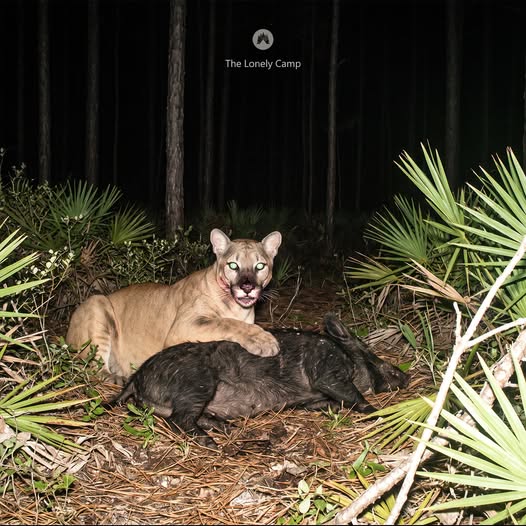
In 1994, Florida panther FP29 killed and ate a hog, then the hog killed him. The feral hog was carrying pseudorabies and showed no symptoms. The panther died when the virus reached his brain.
Pseudorabies has nothing to do with rabies. It is a herpes virus. In its natural host, the feral pig, it circulates quietly. A pig can carry it for life without losing weight, without changing behavior, without showing any sign that it is carrying something that will kill nearly any mammal that eats it. The virus evolved alongside swine over millions of years. The pig’s immune system holds it in check. Every other mammal’s immune system does not.When a Florida panther kills a feral hog and eats the infected tissue, the virus enters the panther’s body through the gut and begins migrating toward the central nervous system. The Florida Fish and Wildlife Conservation Commission describes the progression as rapid. The panther may appear normal for a day or two. Then it stops eating. Its coordination deteriorates. It develops seizures. Within 48 hours of the first symptoms, it is dead. No infected wild panther has ever recovered. No vaccine exists for wild cats.FP29 was the first confirmed case. Researchers at the University of Florida isolated a virulent strain of the virus from his brain after death and published the finding in Glass et al. 1994. They identified feral swine consumption as the likely route of infection and flagged the virus as a potential threat to the entire panther population.For the next 25 years, only two more cases were confirmed. Then in 2021, Cunningham and colleagues at FWC went back through the archives. They pulled tissue samples from 46 panther deaths that had been classified as undiagnosed or unknown cause. They tested the archived tissue with real-time PCR, a technology that did not exist when many of those panthers died. Seven more cases appeared. The total jumped from three confirmed to ten. The researchers estimated the true number of pseudorabies deaths among radio-collared panthers at 15, representing nearly nine percent of all monitored panther mortality between 1981 and 2018. If probable and suspected cases were included, the number could reach 32, representing 19 percent.The title of their paper said what 27 years of undercount had hidden: pseudorabies is an underdiagnosed cause of death in the Florida panther.About 35 percent of Florida’s wild hogs carry the virus. In some areas the prevalence exceeds 50 percent. A panther hunting in the Big Cypress or the Everglades or the Caloosahatchee corridor has roughly a one-in-three chance that the hog it kills tonight is carrying something that will reach its brain within a week. The panther cannot smell the virus. It cannot detect the infection in a living pig that shows no symptoms. It eats what it catches because that is what a panther does.A University of Florida study by Samantha Wisely found that dog hunting on public lands increased pseudorabies shedding in wild hogs. Stressed pigs shed more virus. A hog chased by dogs and then killed or escaped carries a higher viral load in its tissue than a hog that was never pursued. The study recommended prohibiting dog hunting in areas where panthers and hogs share habitat. As panthers expand north into the Kissimmee River Valley, they are moving into public lands where dog hunts are permitted.The Florida panther’s three leading causes of death are vehicle strikes at 59 percent, fights with other panthers at 16 percent, and somewhere in the remaining 25 percent, a virus that a pig carries without knowing it and a panther catches by doing exactly what it evolved to do.Image is for illustration purposes only
Source: Glass et al. (1994) / Cunningham et al. (2021), Journal of Wildlife Diseases / FWC Panther Health / National Geographic / Wisely et al., University of Florida.
Another pig related threat to North America.
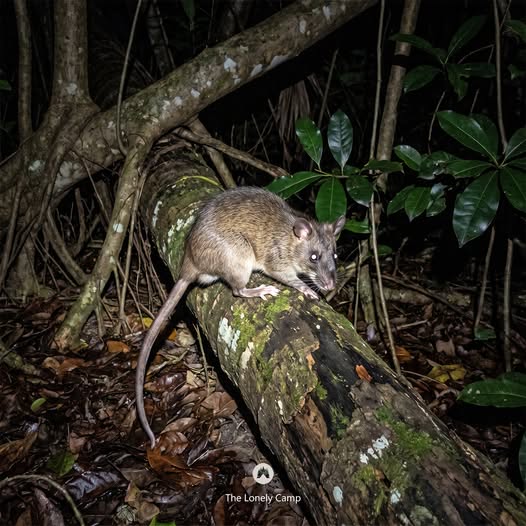
Eight giant African rats escaped from a pet breeder in the Florida Keys around 1999 and founded a wild population on a 550-acre island. The Gambian giant pouched rat weighs up to nine pounds, measures three feet from nose to tail, and is the largest true rat in the world. Nobody noticed the escaped animals for five years. By the time biologists confirmed the population in 2004, the rats had been breeding unchecked on Grassy Key, had crossed a causeway to the neighboring island of Crawl Key, and had survived a direct hit from Hurricane Wilma. Computer models showed that if they reached the Florida mainland, they could successfully invade a large portion of North America.
The Gambian giant pouched rat is native to sub-Saharan Africa, where it feeds on insects, snails, nuts, seeds, and fruit, storing food in the enormous cheek pouches that give it its name. It is not a sewer rat that grew large. It is a different species entirely, built heavier, longer, and more resilient than any rat native to North America. It can produce five litters in nine months, averaging four young per litter. A single breeding pair can become a population faster than any native Florida rodent.The breeder who released or lost the original eight has never been publicly identified. FWC confirmed the only known sightings in Florida have been in the Keys, with breeding established on Grassy Key, a small island that is part of the city of Marathon in Monroe County. The rats preferred the dense tropical hardwood hammocks and overgrown residential lots where they could burrow and feed without being seen. Residents who spotted them assumed they were opossums. They were not.The animals are also known vectors of monkeypox. In 2003, imported Gambian pouched rats in a Texas exotic animal facility transmitted the virus to co-housed prairie dogs, which then infected 72 people across the Midwest in the first monkeypox outbreak in the Western Hemisphere. No rats trapped from Grassy Key have tested positive, but the viral capacity is documented and was part of the urgency behind the eradication effort.USDA Wildlife Services and FWC launched removal operations in 2007 after a pilot eradication on Crawl Key appeared successful. The methods included specialized bait stations designed to exclude native Key Largo woodrats and other wildlife, toxicant testing, tracking tiles coated in fluorescent powder, radio-telemetry, night-vision surveys, and road-kill monitoring along the single highway running through the island. Every technique had to be developed from scratch because nobody had ever tried to eradicate this species from a tropical island before.By 2010, FWC believed the rats were gone. Spokeswoman Carli Segelson told reporters the eradication was complete. Four years later, new sightings proved otherwise. In 2014, FWC distributed fliers to homes on Grassy Key alerting residents to be aware of the rodents, which were still being reported in the same neighborhoods where the eradication had supposedly ended.Ron Magill, communications director at Zoo Miami, described the problem to the New Times: this is the largest true rat in the world, and it just will not go away. The remaining population was sparse enough to avoid detection but dense enough to keep breeding. The 2010 USDA paper noted that detecting, baiting, trapping, and removing the now sparse population of Gambian rats are proving difficult. The rats had entered the same trap-educated survival state documented in feral hogs: the easy ones were caught first, and the survivors were the ones that avoided everything.As of the most recent federal listing, the Gambian giant pouched rat is still classified as established on Grassy Key. The State of Florida lists it as a prohibited species. It cannot be possessed except for research, educational exhibition, and eradication. The concern that drove the computer models in 2004 has not gone away: the mainland is connected to the Keys by a single highway, and a pregnant rat can cross a causeway.
Source: USDA National Wildlife Research Center / FWC / National Invasive Species Information Center / Broward-Palm Beach New Times / WTKR.
News to me and bad news.