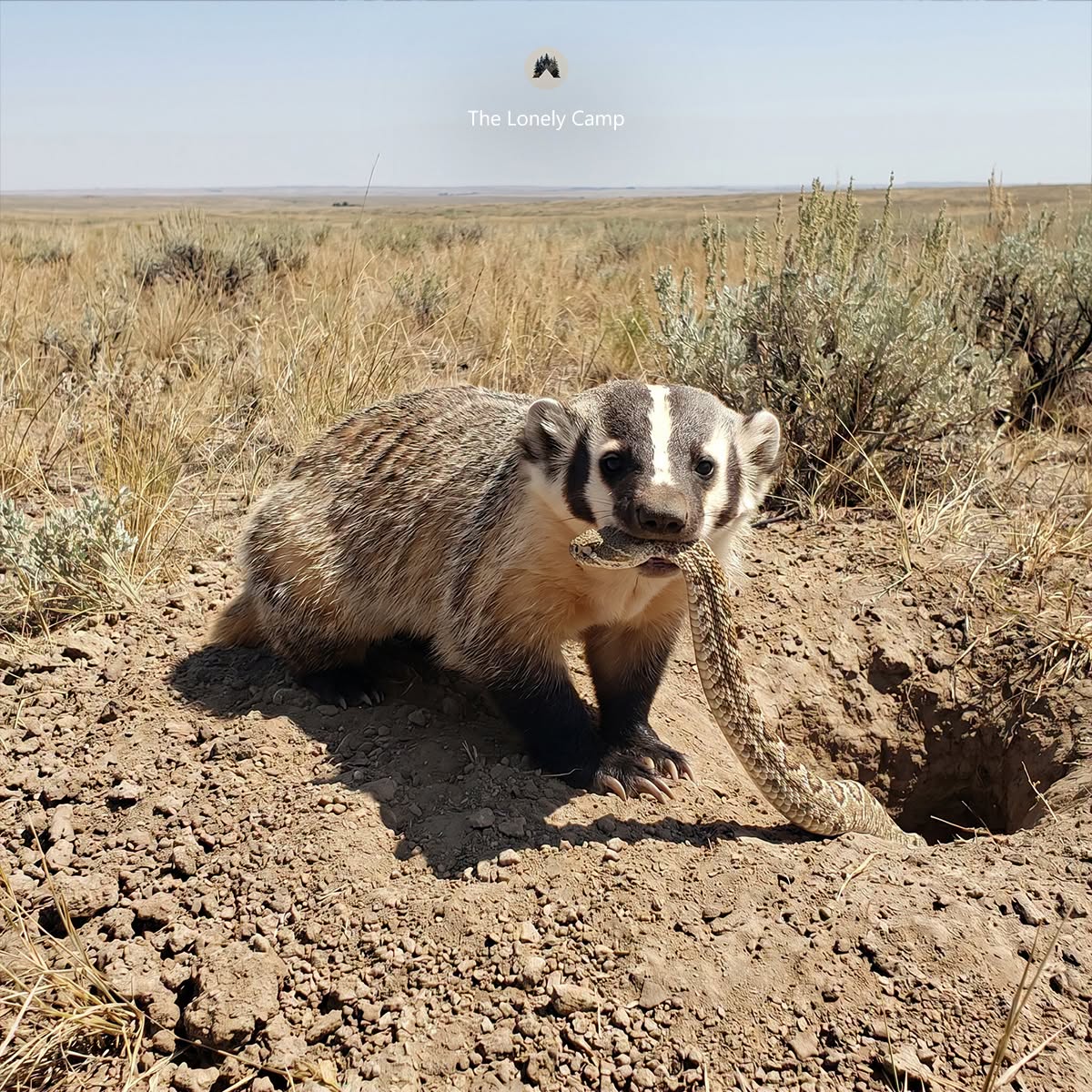
The American badger digs rattlesnakes out of their dens, absorbs their bites, and eats them. In South Dakota, it is considered the rattlesnake’s most important predator.
A rattlesnake in its den is supposed to be safe. The burrow is narrow, dark, defensible, and the snake can coil and strike at anything that enters. Against a badger, the den is a trap. The badger does not enter the hole. It excavates around it. The same claws that can dig through blacktop and rip open a ground squirrel tunnel in seconds will peel the roof off a rattlesnake den and expose the coiled animal to open air, where the badger’s jaws are waiting. The snake strikes. The badger takes the hit. The badger keeps digging.DesertUSA describes this plainly: the badger hunts one of its favorite prey, the rattlesnake, with impunity because, with the exception of its nose, it seems to be immune to the serpent’s venom.The resistance is not fully understood. The badger’s first line of defense is physical, not chemical. Its skin is extraordinarily thick, loose, and tough, a hide that moves independently of the muscle and bone beneath it. When a rattlesnake strikes a badger’s flank or shoulder, the fangs often fail to penetrate through the loose skin deep enough to reach vascularized tissue where the venom would enter the bloodstream. The skin absorbs the strike the way a heavy leather jacket might absorb a thorn. Some researchers believe there is also a biological component, a resistance in the badger’s bloodstream that neutralizes whatever small amount of venom does get through, but this has not been confirmed with the same molecular precision as the documented venom resistance in honey badgers or mongooses.What has been confirmed is the outcome. Badgers eat rattlesnakes routinely across the western United States. They eat prairie rattlesnakes, western diamondbacks, and timber rattlesnakes in the regions where both species overlap. They dig them from winter dens where rattlesnakes congregate in large numbers, sometimes dozens of animals coiled together in a single hibernaculum. A badger that finds a rattlesnake hibernaculum in October or November has found a refrigerator stocked with slow, cold, barely responsive prey that cannot mount a fast strike because its muscles are too cold to contract at full speed. The badger digs in and feeds.During warmer months, when rattlesnakes are active and their strike speed is at full capacity, the badger still hunts them. The approach is what Biology Insights describes as brute force: the badger uses its heavy build and powerful jaws to quickly subdue the snake before consuming it. There is no circling, no feinting, no careful avoidance of the head the way a roadrunner or a kingsnake might approach. The badger is built like a brick. It weighs 15 to 25 pounds, carries most of its mass low to the ground, and its muscular neck and flat skull give its jaws a leverage advantage over anything it can get its teeth around. It bites and it does not let go.A rattlesnake in the jaws of a badger is dead in seconds.The nose is the weak point. The skin on a badger’s snout is thinner and more vascularized than anywhere else on the body. A rattlesnake bite to the nose can deliver venom directly into tissue with heavy blood flow, bypassing the armor that protects the rest of the animal. Badgers that are bitten on the nose may experience swelling, pain, and in rare cases, serious envenomation. Whether badgers have learned to protect their noses during snake encounters, by tucking the head and leading with the armored forehead and jaw, is not documented in the literature. But the pattern is consistent across multiple sources: everywhere else on the body, the venom does not seem to matter.The Animal Diversity Web at the University of Michigan lists the American badger as a significant predator of venomous snakes and notes its role in controlling their populations. A single badger holding a territory that includes a rattlesnake hibernaculum can reduce the local snake population year after year by raiding the same den site every autumn. The snakes cannot relocate. They return to the same hibernaculum their mothers used because the sites with the right depth, temperature, and drainage are rare. The badger knows where they are. It comes back every year. The snakes come back every year. One side has venom. The other side does not care.
Source: DesertUSA / Biology Insights / Animal Diversity Web, University of Michigan / NHPBS NatureWorks / Animals Around the Globe / Wikipedia, citing Long (1999), The Smithsonian Book of North American Mammals.
I didn’t know they did this.
Striped skunks in British Columbia appear to systematically hunt rattlesnakes at their winter dens. John Macartney, a graduate researcher at the University of Victoria studying western rattlesnake ecology across the province’s southern interior in the early 1980s, kept finding evidence that the same predator was visiting his study animals’ hibernacula and killing them in a pattern that looked less like chance encounters and more like a hunting strategy.
A skunk might seem like a slow, waddling animal that relies entirely on its spray. It is not. A skunk attacking prey moves with a speed that does not match its reputation. The killing method Macartney reconstructed from the carcasses was consistent across sites and clearly the work of something fast and precise. Crushed skulls. Small tooth marks concentrated on the head. Chewed tails. The skunk closes the distance low to the ground, gets behind or beside the snake before it can orient, and bites down on the head to disable the fangs. The skull crush follows. The entire attack appears to be built around one principle: get to the head before the head gets to you. The tail damage may be from initial contact or from dragging. The result at every site was the same: a dead rattlesnake beside its own den with tooth marks too small for a coyote and too large for a weasel.Skunk tracks appeared beside freshly dug excavations at multiple hibernacula and basking areas. At one dig site, a chewed rattlesnake tail lay near the entrance. Nearby, Macartney found a juvenile male rattlesnake with its skull crushed and small tooth marks across its head. At another den, a gravid female had identical head wounds and a chewed tail. Three striped skunk scats collected in the study area contained rattlesnake remains. Macartney identified the bone sizes: one scat held the remains of an adult, one a juvenile, and one a neonate. The skunks were eating every age class the dens produced.Canada’s Committee on the Status of Endangered Wildlife cited the findings directly in the 2004 national status assessment for the western rattlesnake, stating that Macartney’s observations suggested skunks actively pursue rattlesnakes around their hibernacula. The federal government took a graduate student’s fieldwork and used the word “actively” in a national species assessment. That word choice separated the skunk’s behavior from opportunistic predation and placed it closer to deliberate hunting.The timing is what makes it work. A rattlesnake hibernaculum is a crack system, a talus slope, or a rocky outcrop with deep crevices where dozens or hundreds of rattlesnakes spend the winter below the frost line. In spring, the snakes emerge slowly. They bask on the rocks near the den entrance for days or weeks, sluggish from months of dormancy, their metabolism barely running. A rattlesnake basking beside its hibernaculum in early April is the most vulnerable it will be all year. Below 60 degrees Fahrenheit, a rattlesnake’s overall movement deteriorates sharply. It cannot flee quickly. It cannot recoil into a proper defensive posture. It can still strike.A 2020 study in the Journal of Experimental Biology found that cold rattlesnakes retain more strike speed than anyone expected, losing only about 25 percent even at the lowest test temperatures because the snakes store elastic energy in their tendons the way a drawn bow stores energy in the string. But strike accuracy drops in the cold. A rattlesnake that can still lunge at 75 percent speed from a bad angle against an attacker it did not have time to turn and face is a rattlesnake that is fast enough to be dangerous and too stiff to be precise.
The skunk does not need the snake to be slow. It needs the snake to miss. And it can afford to get hit. A striped skunk weighs 6 to 14 pounds. A western rattlesnake in the British Columbia interior averages two to three pounds. The weight advantage alone is enough, but the skunk carries something more specific: a documented resistance to pit viper venom. Skunks, like opossums and honey badgers, tolerate rattlesnake venom at doses that would kill similarly sized mammals. A bite that drops a rabbit may slow a skunk without killing it. The skunk can absorb a defensive strike that lands and continue the attack. A cold rattlesnake that strikes fast but misses gets no second chance. A cold rattlesnake that strikes fast and connects gets a second chance only if the venom works fast enough to stop what is already biting through its skull, and in a skunk it does not.