Homo erectus back to 2 million years plus Whathisname

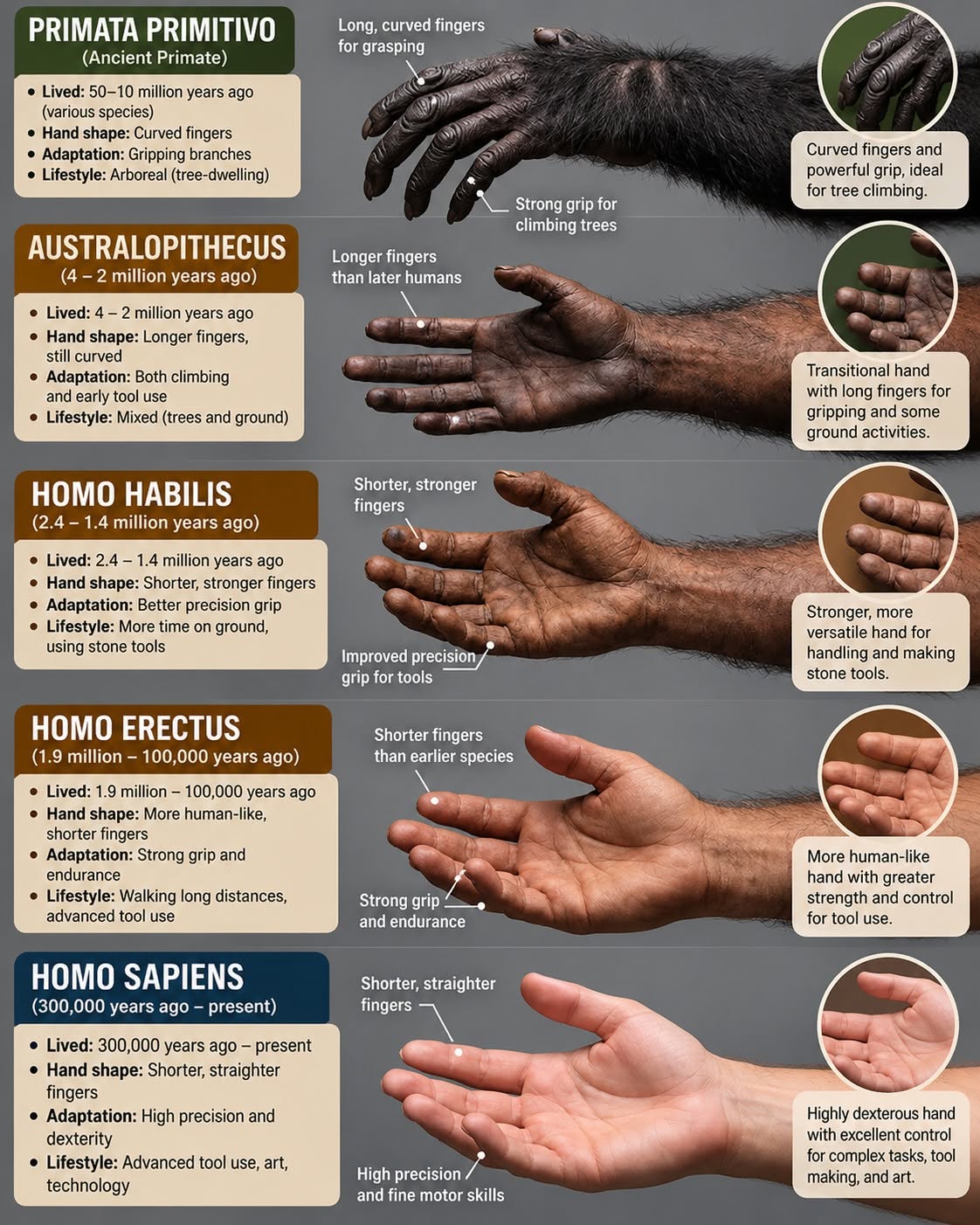
🖐️🧬 The Evolution of the Human Hand — From Climbing to Creating! Millions of years of evolution shaped the hands of our ancestors. Early primates had curved fingers well suited for gripping branches, while later hominins developed hands capable of increasingly precise movements. 🦴 Did you know? 🌿 Early primates used their hands for climbing and grasping. 🪨 Homo habilis is associated with early stone-tool traditions. 🚶 Homo erectus had human-like hands and used stone tools. 🎨 Homo sapiens can perform incredibly precise movements, helping us create tools, art, and complex technology. Evolution wasn’t a simple straight line. Different species had different adaptations, and the fossil record doesn’t preserve every detail of how hand function changed. Which ability do you think changed human history the most: gripping, making tools, or creating art? Source


The fossil record shows that our Homo erectus ancestors were the first hominins to show signs of adapting to life on the ground, with longer legs and shorter arms emerging (the name translates to ‘upright human’).

It’s therefore important that anthropologists can date the species correctly – and a new fossil analysis from an international team of researchers, published in the Annals of Human Biology, pushes back the emergence of these proto-people by about 200,000 years.
The discovery comes from the Drimolen Main Quarry near Johannesburg in South Africa, a hugely significant site for early humans known as the ‘Cradle of Humankind’. What’s more, the study includes additional findings for a more distant ancient human relative.

Homo erectus back to 2 million years.

The records kept getting deeper in time. The hand info may not be reliable.

New fossil discoveries confirm that Homo erectus emerged approximately 2 million years ago, pushing back the species’ known appearance in southern Africa by roughly 200,000 years. [1, 2]
Key Facts About the 2-Million-Year Timeline
  • South African Discoveries: An international research team described a 2-million-year-old adult Homo erectus skull fragment and related fossils from the Drimolen Main Quarry in the Cradle of Humankind near Johannesburg. [1, 2, 3]

  • Coexistence with Paranthropus robustus: At the Drimolen site, Homo erectus lived side-by-side with Paranthropus robustus, an evolutionary relative that heavily outnumbered them (more than 10 to 1 at the site) and adapted to changing climates with larger teeth and stronger chewing muscles. [1, 2]

  • Earliest Record: This southern African find matches or predates other early Homo erectus evidence found in East Africa and Ethiopia, reshaping timelines previously anchored around 1.8 to 1.9 million years ago. [1, 2, 3]

  • Longest-Lived Human Species:Homo erectus survived on Earth for nearly 2 million years—vastly longer than Homo sapiens have existed—spreading out of Africa into Western and East Asia. [1, 2, 3]

AI summary on it.
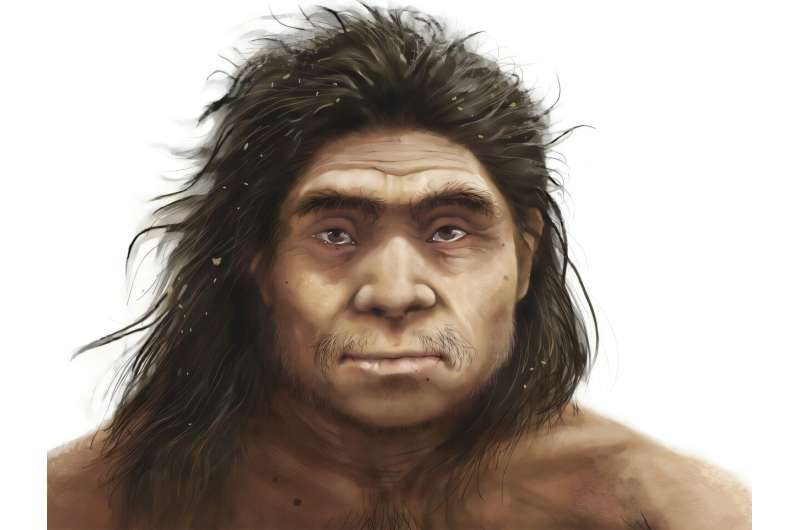
 

thanks to a new study published in the journal Nature, some significant knowledge gaps are being filled in—namely, what they looked like and where they lived.

The answers came from analysis of a skull fragment and a jaw fragment excavated alongside other fossils from the Xujiayao archaeological site in northern China between 1976 and 1979.

What ancient Denisovans may have looked like

I swear I know him but can’t place the name.

Leave a comment

Your email address will not be published. Required fields are marked *