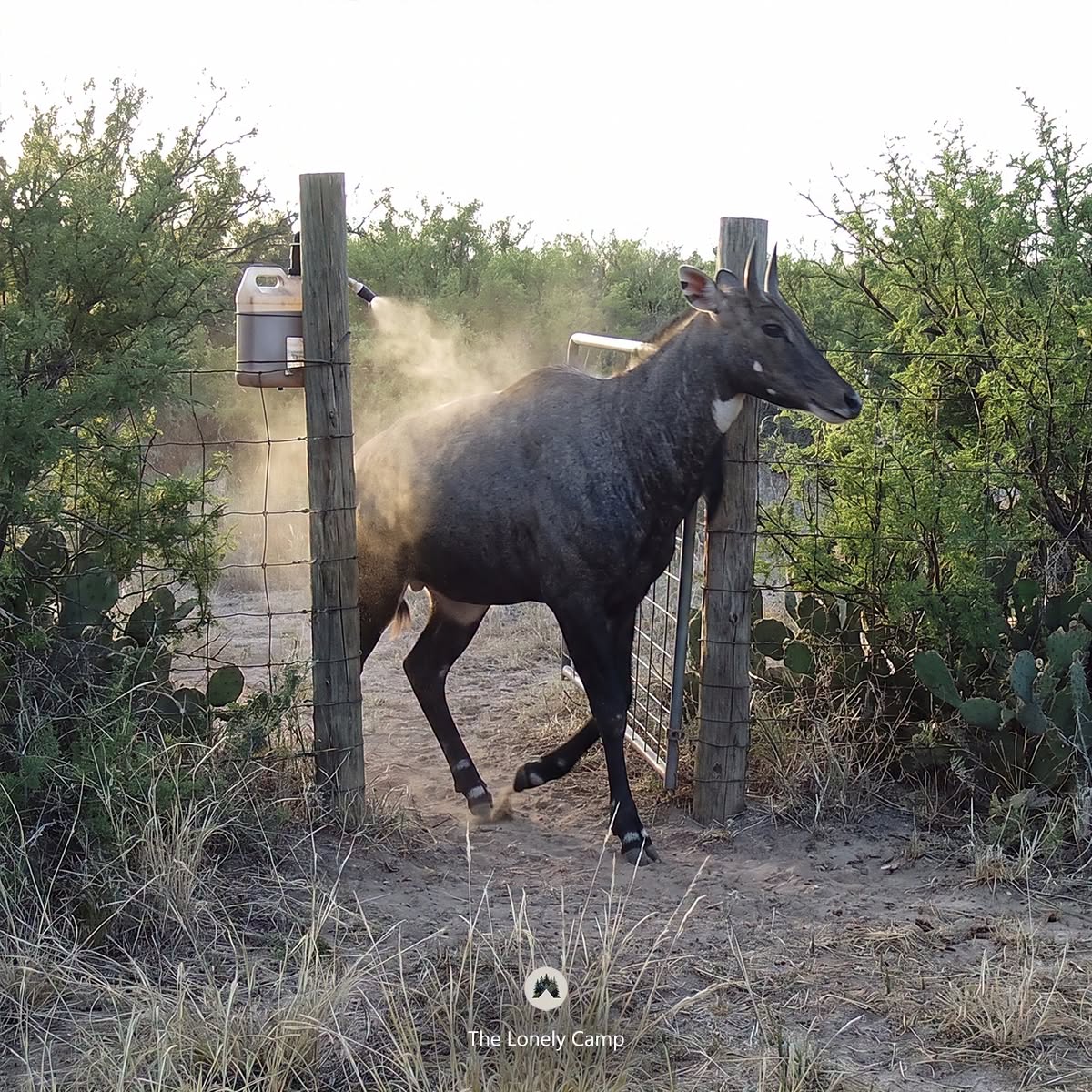
USDA researchers in South Texas built a battery-powered sprayer, hid it at a fence crossing where wild nilgai antelope squeeze through the wire, and loaded the tank with billions of microscopic parasitic worms suspended in water. When an antelope walked through the gap, an ultrasonic sensor detected its movement, an onboard computer started the pump, and the machine sprayed the animal’s belly and legs with living roundworms that kill ticks.The target was the southern cattle fever tick. The tick carries bovine babesiosis, a blood disease that could devastate the American cattle industry if it spreads beyond the quarantine zone along the Rio Grande. Cattle can be gathered and dipped. Nilgai cannot. A nilgai antelope stands five feet at the shoulder, weighs up to 600 pounds, jumps fences, and does not cooperate with livestock handling in any form. The USDA had been shooting them from helicopters at Laguna Atascosa National Wildlife Refuge, killing hundreds, and the tick kept spreading because the surviving nilgai kept carrying it across ranch boundaries.John Goolsby, a USDA research entomologist at the Cattle Fever Tick Research Laboratory in Edinburg, Texas, proposed a different approach. It is no surprise that the cattle fever tick gets on nilgai, he said, because they both come from India, the tick and the nilgai. Nilgai were imported as zoo animals in the 1920s and later released in South Texas. The tick was already in the region. The two species from the same subcontinent found each other on the same ground 10,000 miles from where they evolved together.The weapon Goolsby chose was Steinernema riobrave, a microscopic roundworm native to the Rio Grande Valley. It is an entomopathogenic nematode, meaning it parasitizes and kills insects and ticks. It enters the tick through a body opening, releases bacteria that liquefy the tick’s internal organs, feeds on the resulting material, reproduces inside the carcass, and sends its offspring into the soil to find more hosts. Goolsby’s team had already demonstrated in the lab that the nematode kills cattle fever ticks. The problem was getting the nematode onto a nilgai.The sprayer solved it. Goolsby and colleagues at the University of Texas Rio Grande Valley, including Diana Cantu, Alejandro Vasquez, and Alexis Racelis, built the device from off-the-shelf components. The tank held the nematode solution. An aerator ran continuously to keep the worms alive and oxygenated in the Texas heat. Tests showed the nematodes stayed viable in the aerated tank for more than two weeks. The ultrasonic sensor triggered the spray when an animal passed. The system ran on batteries and required no human presence.They demonstrated the sprayer publicly on November 20, 2017, at Russell Ranch near Rio Hondo. In the summer of 2019, they deployed sprayers across six private ranches in Cameron County totaling 40,000 acres. Researchers used satellite-collared nilgai and game cameras to compare tick counts in treated and untreated areas. The results showed a significant treatment effect.Later work placed motion-triggered sprayers at water troughs and monitored them with 16 cameras from 2020 through 2022. The nilgai kept visiting the equipped troughs. They did not avoid the spray. An animal walking through a mist of water on a hot South Texas day has no reason to object, and the microscopic worms landing on its hide are invisible, odorless, and already native to the dirt under its feet. The nilgai does not know it has been treated. It walks through the fence crossing or drinks from the trough, picks up a few billion roundworms, and carries them into the brush where the ticks are waiting.The technique remains experimental. Goolsby and his team recommended further testing before incorporating the system into the wider Cattle Fever Tick Eradication Program. We have been able to prove that we can spray nilgai, and we know that the nematodes kill the tick, Goolsby said in 2019. But what we do not know is, when the whole thing comes together, can we reduce ticks enough to make a difference at scale.Source: Goolsby, Cantu, Vasquez, and Racelis (2019), Subtropical Agriculture and Environments / Goolsby and Shapiro-Ilan (2020), Biocontrol Science and Technology / USDA ARS / MyRGV / Texas Farm Bureau / Las Huellas Association.
I mentioned moose ticks before here and how they are devastating moose populations. I was pleased to see something that might help.