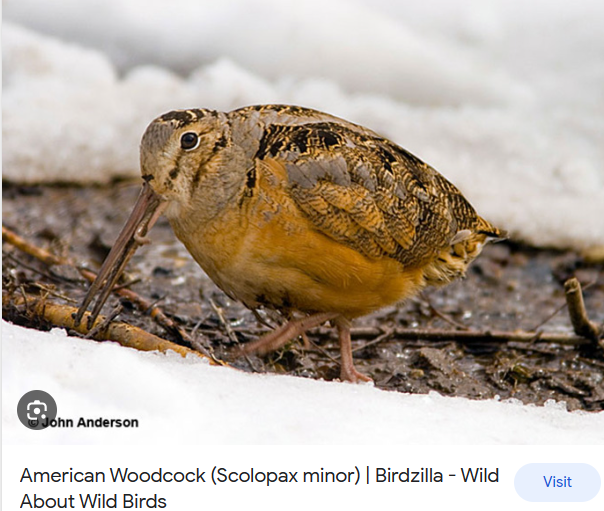
Pleistocene Woodcock (Scolopax minor)
I see woodcock on my land frequently, like 2 days ago, so I saw this with interest. It has been many years since I shot and ate one but I always get a thrill when they flush. I always had some questions about them. Some answers are below.
Females lay eggs on the ground and carry their slow-developing young between their legs.
I heard the leg carry thing was a disproven myth. Am I wrong?
I looked at his Woodcock in the Southeast reference and saw:
Even after the Ice Ages ended, earthworms did not recolonize most of New England and Canada until after Europeans introduced non-native species of earthworms there. Europeans brought earthworms in dirt used as ship’s ballast and in fruit tree root balls encased in dirt. Woodcocks rapidly extended their summer breeding ranges to these regions in response to the new source of food.
Really? News to me.
For most of his days, a woodcock eats worms— worms for breakfast, worms for lunch, worms for dinner. A woodcock without worms is in big trouble.
I didn’t think they were that dependent and specialized.
Some of the woodcock’s favorite worms in northern states are Aporrectodea tuberculata, Lumbricus rubellus and Dendrobaena octaedra (Reynolds 1977). Surprisingly, none of these three favorite worms is native to America. All are introduced European species. Apparently the woodcock’s original worm foods have been replaced by a number of species introduced from Europe and elsewhere.
Also, a surprise.
A stunningly abundant worm in some places is the large nightcrawler Lumbricus terrestris. This worm, introduced from Europe, has spread over vast areas, but its spread has not been good news for the woodcock; they rarely eat this kind of worm. The woodcock’s world of worms has been changed. No one knows what has happened to the woodcock’s former favorite worms.
I wondered. Now, I know.