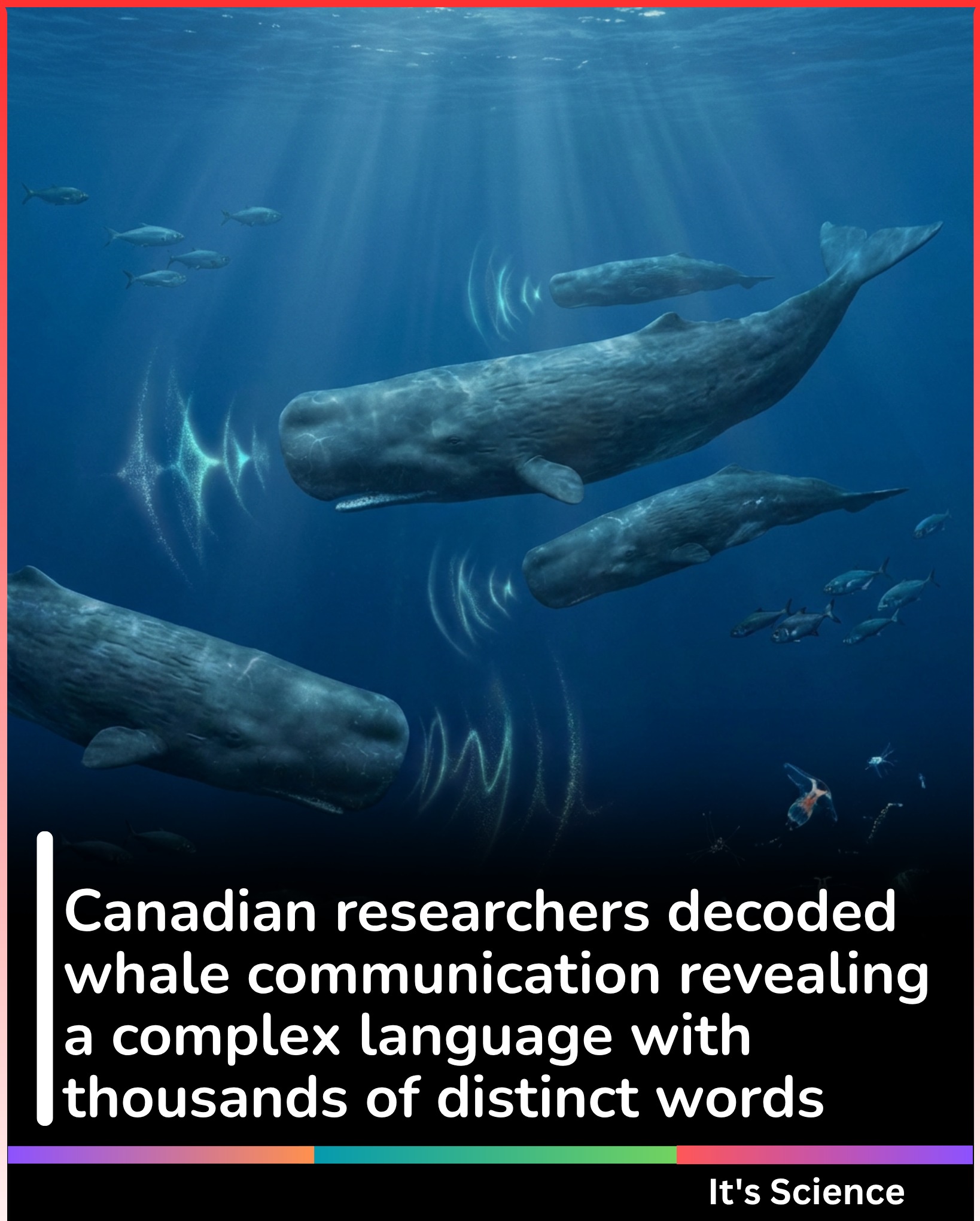
Canadian researchers decoded whale communication revealing a complex language with thousands of distinct words.A collaborative project between Dalhousie University and the nonprofit Project CETI (Cetacean Translation Initiative) has produced the most detailed acoustic analysis of sperm whale communication ever assembled, and the findings published in 2025 are genuinely startling. Sperm whale click patterns — called codas — do not form a simple signaling system. They appear to operate as a structured combinatorial language, with individual units combining according to grammatical rules to produce a vocabulary of over 10,000 distinct communicative units.
The analysis used machine learning models trained on over 4 billion individual click recordings captured by hydrophone arrays deployed across sperm whale feeding grounds in the Caribbean.The AI identified not just the coda patterns themselves, but context-dependent variations — the same coda sequence produced in different social situations carries measurably different structural modulations, suggesting the kind of contextual meaning assignment that is a hallmark of true language rather than simple signal. Whale groups in different ocean basins even show regional dialect variations analogous to human language accents.
The philosophical implications are difficult to overstate. If sperm whales possess a genuine language with combinatorial grammar and contextual semantics, they join humans as the only known species with this level of communicative complexity.Questions about whale cognition, social culture, and even moral status take on a completely different weight in that context. It changes how we must think about whaling, captivity, and the disruption of whale acoustic environments by shipping noise.
Project CETI’s next phase involves deploying AI translation models designed to generate human-interpretable meaning from whale codas in real time. The age of talking to whales may be closer than any science fiction writer imagined.Project CETI (Cetacean Translation Initiative), in collaboration with researchers from Dalhousie University, has made significant breakthroughs in understanding sperm whale communication, as reported in Nature-affiliated journals in 2025–2026. They are using AI to analyze whale “codas” (click patterns) to decode their language, documenting rare social behaviors.
Nature +4Key 2025-2026 Findings and Research (Project CETI & Dalhousie)
- Deciphering the “Alphabet”: Researchers have identified a complex, almost phonetic “alphabet” within sperm whale codas, hinting at a structured, combinatorial communication system.
- AI and Acoustic Monitoring: The project uses advanced machine learning (such as the WhAM model) and sub-surface robotic technology to record and analyze sound and movement in real time near Dominica.
- Groundbreaking Social Observations: In March 2026, researchers documented a rare collaborative birth event, revealing that female sperm whales provide collective support for each other during calving.
- Cultural Clans: Studies, including work by Dr. Hal Whitehead of Dalhousie University, show that female sperm whales form large cultural clans based on shared vocalizations, similar to human ethno-linguistic groups.
- Minimal Intervention: The team employs high-tech, minimally invasive technologies like suction-cup computers and drones to study the Eastern Caribbean sperm whale population without disturbing them.
Instagram +6Collaborators
- Dalhousie University: Long-term population studies and social structure analysis (Dominica Sperm Whale Project).
- Project CETI: A multidisciplinary initiative bringing together scientists from institutions like MIT, Harvard, and City University of New York to apply AI to interspecies communication.
- Nature/Scientific Reports: Publishing key findings regarding the “coda” and vocalization analyses.
Carleton University +4
Dramatic stuff if it is accurate.
I used to work in the same department.