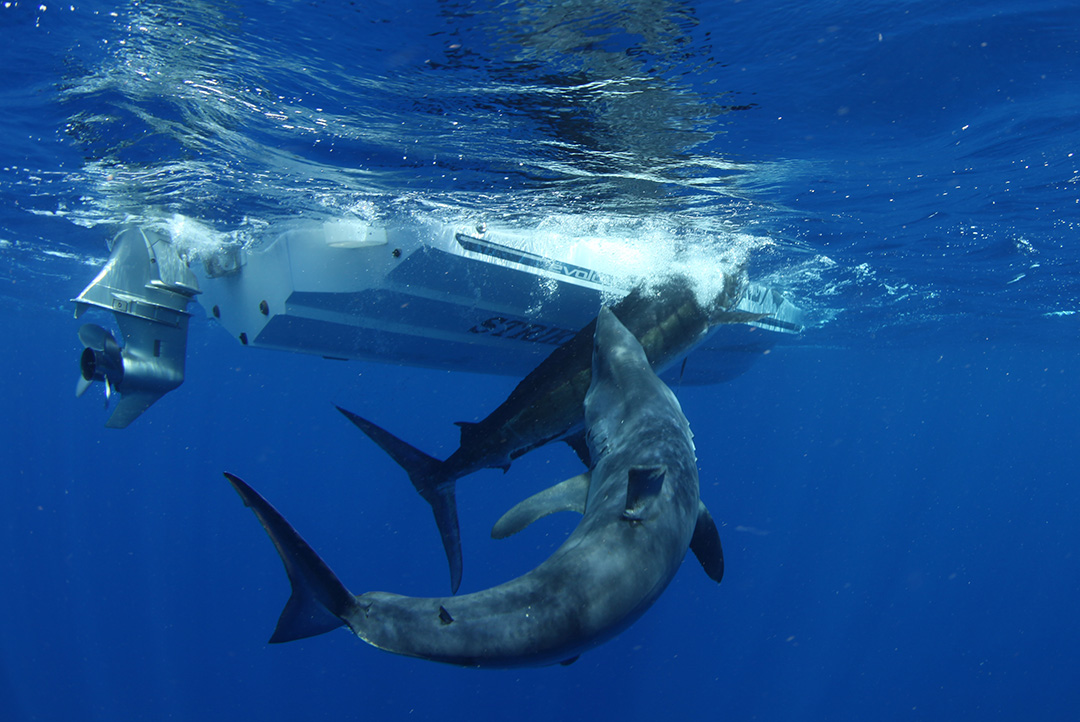
IMAGE: Photographer, @almcglashan, captures the moment a giant mako shark attacks a blue marlin that was being released boat-side. Pelagic
The Old Man and the Sea relived?
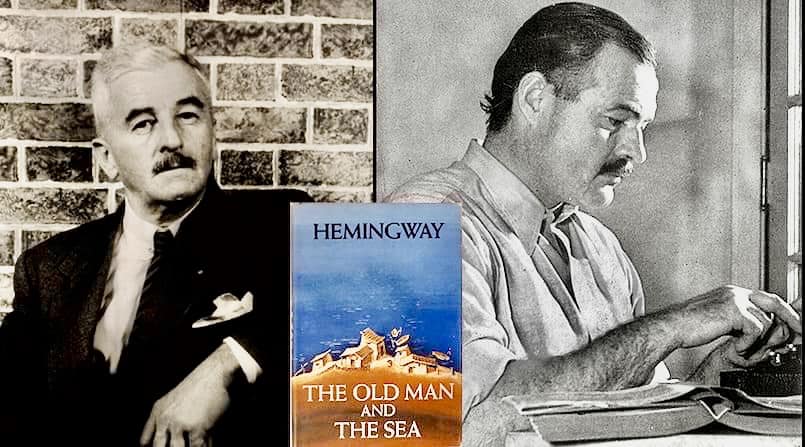
William Faulkner’s 1952 Review of The Old Man and the Sea
“Time may show it to be the best single piece of any of us.”In the midcentury American literary landscape, few writers loomed as large as William Faulkner and Ernest Hemingway. Both were revered internationally as well as at home, both won Nobel and Pulitzer Prizes, both wrote acclaimed short fiction alongside their novels, and both drank like fish.Universal renown and debilitating alcoholism are where the similarities pretty much end, however. Hemingway was the quintessential minimalist, shearing his terse sentences of any and all ornamentation; Faulkner was a purveyor of experimental, elliptical, stream-of-consciousness prose. Hemingway was the bombastic veteran and war correspondent, a tornado of chest-beating machismo and unchecked ego; Faulkner was a taciturn former postmaster who despised and shunned the fame that success brought. Hemingway sent his rootless, restless surrogates to far-flung lands; Faulkner built an imagined county in which his haunted Southerners could decay.What they did share, however, was a healthy rivalry, and though they never met in person, the two men corresponded, both in the press and in private, for years. Their most famous interaction, indeed the one that has come to epitomize their relationship in the public imagination, came when Faulkner remarked that Hemingway “has never been known to use a word that might send a reader to the dictionary,” to which Papa replied, “Poor Faulkner. Does he really think big emotions come from big words?”Despite what this catty exchange would have you believe, Faulkner and Hemingway were actually great admirers of each other’s work, regularly offering up (qualified) praise. Perhaps the greatest single example of this came in 1952, when Faulkner agreed to write the below single-paragraph review of The Old Man and the Sea for Washington and Lee University’s literary journal, Shenandoah.
“His best. Time may show it to be the best single piece of any of us, I mean his and my contemporaries. This time, he discovered God, a Creator. Until now, his men and women had made themselves, shaped themselves out of their own clay; their victories and defeats were at the hands of each other, just to prove to themselves or one another how tough they could be. But this time, he wrote about pity: about something somewhere that made them all: the old man who had to catch the fish and then lose it, the fish that had to be caught and then lost, the sharks which had to rob the old man of his fish; made them all and loved them all and pitied them all. It’s all right. Praise God that whatever made and loves and pities Hemingway and me kept him from touching it any further.” – William Faulkner Finding My Hemingway
Ernest Hemingway’s 7 Tips for Writing:1: To get started, write one true sentence.“Sometimes when I was starting a new story and I could not get it going, I would sit in front of the fire and squeeze the peel of the little oranges into the edge of the flame and watch the sputter of blue that they made. I would stand and look out over the roofs of Paris and think, ‘Do not worry. You have always written before and you will write now.’”2: Always stop for the day while you still know what will happen next.“The best way is always to stop when you are going good and when you know what will happen next. If you do that every day when you are writing a novel you will never be stuck.”3: Never think about the story when you’re not working.“I had learned already never to empty the well of my writing, but always to stop when there was still something there in the deep part of the well, and let it refill at night from the springs that fed it.”4: When it’s time to work again, always start by reading what you’ve written so far.“When it gets so long that you can’t do this every day read back two or three chapters each day; then each week read it all from the start.”5: Don’t describe an emotion—make it.“In writing for a newspaper you told what happened and, with one trick and another, you communicated the emotion aided by the element of timeliness which gives a certain emotion to any account of something that has happened on that day; but the real thing, the sequence of motion and fact which made the emotion and which would be as valid in a year or in ten years or, with luck and if you stated it purely enough, always, was beyond me…”6: Use a pencil. “If you write with a pencil you get three different sights at it to see if the reader is getting what you want him to. First when you read it over; then when it is typed you get another chance to improve it, and again in the proof.”7: Be Brief.“It wasn’t by accident that the Gettysburg address was so short. The laws of prose writing are as immutable as those of flight, of mathematics, of physics.” History Cool Kids
No idea if the tips are real or made up but they sound good. Maybe they are.