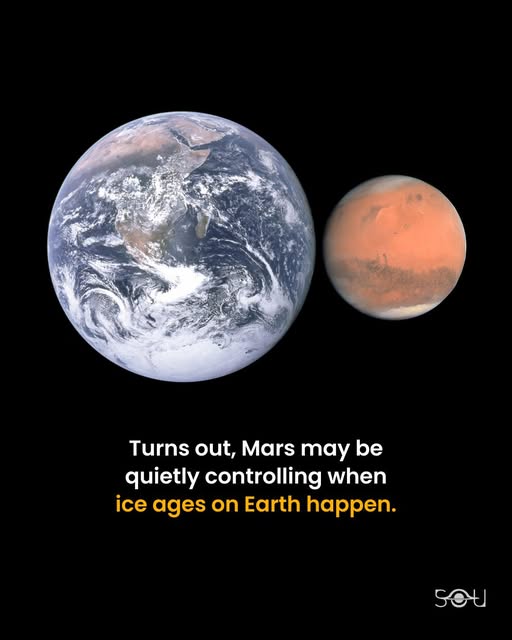
Remove Mars from the solar system, and Earth’s ice age rhythm falls apart. A planet half our size and 140 million miles away is quietly shaping our climate — and has been for billions of years.
Stephen Kane, a planetary astrophysicist at UC Riverside, set out to disprove this idea. He ran computer simulations spanning 100 million years, dialing Mars’s mass from zero to ten times its current value to see what would happen to Earth’s Milankovitch cycles — the slow orbital shifts that control how sunlight reaches our planet and when ice ages begin and end.The 430,000-year cycle driven by Venus and Jupiter? Completely unaffected. But two other critical cycles — a 100,000-year rhythm and a 2.4-million-year “grand cycle” — vanished entirely the moment Mars was removed. Crank up Mars’s mass, and both cycles sped up. Even more surprising, a heavier Mars actually stabilized Earth’s axial tilt, slowing down the wobble that drives glacial advance and retreat.Mars pulls this off because of its distance from the Sun. Farther out, it’s less dominated by solar gravity, allowing it to tug on Earth more effectively than its small size would suggest. As Kane put it, “it punches above its weight.” The findings raise a profound question: without Mars, would Earth’s climate history — and the evolution it drove — look anything like what we know?
RESEARCH PAPER
Kane et al, “The Dependence of Earth Milankovitch Cycles on Martian Mass”, Publications of the Astronomical Society of the Pacific (2025)
Another twist on the confounding issue of what causes ice ages.
Note the size of Mars. It is smaller than many think.