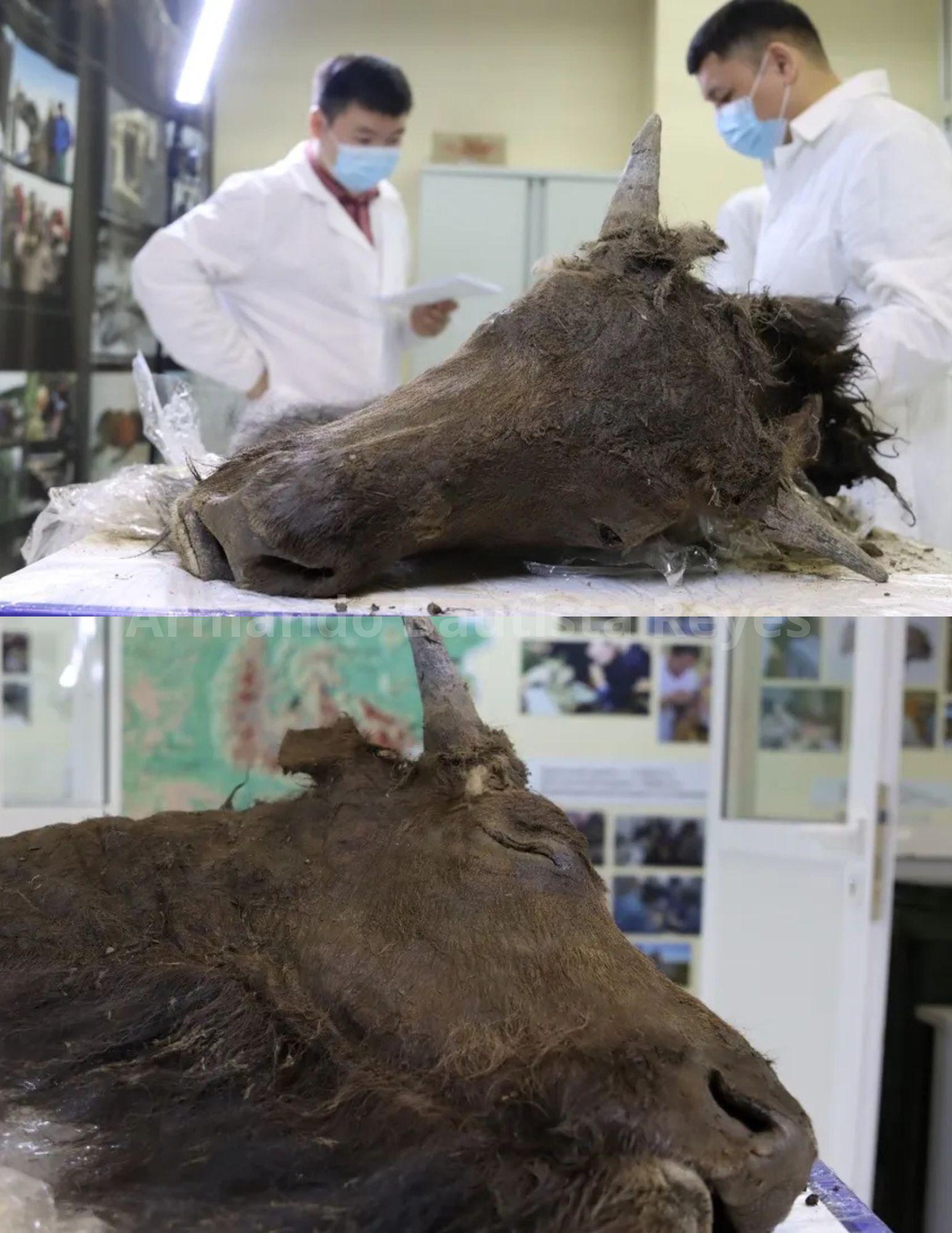
IT WAS FROZEN FOR 9,000 YEARS. NOW THEY’RE TRYING TO CLONE HIM
It is an extinct bison of an unknown species, found between the Verjoyansk Range and the Cherski Mountains, of the Russian Steppes. The finding included the head, anterior limbs and part of the chest. Later in 2022, its discoverer donated it to the Mammoth Museum of the Northeastern Federal University (NEFU), based in Yakutsk, an institution that houses one of the world’s largest collections of Pleistocene and Holocene fauna.Preliminary investigations confirmed that the specimen had been buried in the permafrost for 9,000 years and coincided with the age of other bison found in 2009 and 2010. It was determined to be a young man between 1.5 and 2 years old. The specimen provides genetic material for in-depth study.The attempt to revive the extinct in the laboratoryDuring the necropsy samples of muscle tissue, skin, wool and brain were extracted. Each of those samples can contain DNA sequences, which could be very useful for reconstructing the genome of the animal being attempted to be cloned. Maxim Cheprasov, director of the Mammoth Museum, has stated that the materials selected could be used to clone the bison in the future.There are other institutions that have announced similar advances with extinct wolves from the Pleistocene and with the dodo. However, the only difference is that the muscle tissue of the Siberian bison remains almost intact and this would avoid the need to fill genetic spaces with DNA from related species.This doesn’t guarantee the project will be a success. Even the most complete DNA does not guarantee that a cloning process will work: you would need to find a female European or American bison capable of managing the embryo, and resolve ethical issues that the scientific community has just begun to debate.Meanwhile, Verjoyansk’s bison will remain guarded in the laboratory halfway between definitive death and an unlikely second birth.
(Images Credit: Press Service of the Federal University of Northeast)
That specimen is in incredible condition.