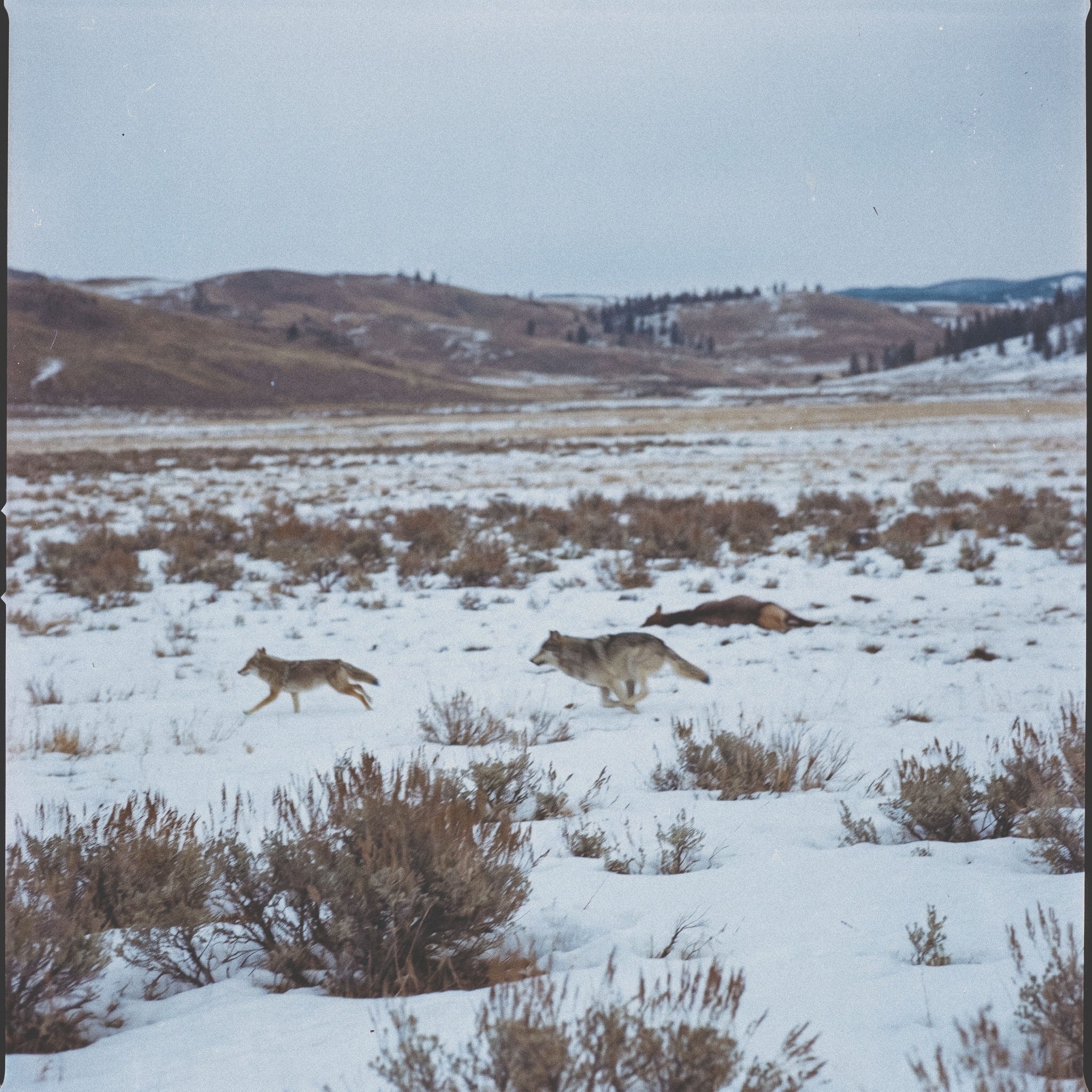
A subordinate male wolf peeled off a winter elk kill at a dead sprint, ran down a coyote in the open snow, broke its spine with a single bite, dropped the body where it fell, and trotted back to the carcass without eating a mouthful.
That sequence was documented repeatedly during the first years of wolf reintroduction in Yellowstone, and it tells you everything about how the hierarchy of the northern Rockies actually functions.
For seventy years, from the mid-1920s until 1995, there were no wolves in Yellowstone. The last ones were shot, trapped, and poisoned out under federal predator control programs, and the moment they were gone, the coyote population restructured itself into something the valley had never seen before. Coyotes in wolf-free Yellowstone did not behave like the nervous, skulking animals you see in places where wolves still operate. They got bigger. They started forming larger packs. They began hunting cooperatively, taking down prey that coyotes in other ecosystems would never attempt. They functionally promoted themselves into the apex predator role and ran the Lamar Valley for three generations without anything above them pushing back.
Then fourteen wolves from Alberta were released into the park in January 1995, and the correction was immediate.
Researchers with the Yellowstone Wolf Project had front-row documentation of what happened when the original management returned to a system that had been running without oversight. The wolves did not gradually pressure the coyotes out. They did not compete with them slowly over seasons and years. They killed them. Quickly, efficiently, and in numbers that stunned the biologists tracking the data.
The mechanics of it followed a pattern that repeated across the Lamar Valley and the surrounding drainages. A wolf pack would bring down a winter elk. The carcass would sit in the snow steaming, and the scent would carry for miles on the cold air.
Coyotes that had spent their entire lives as the dominant scavenger in the basin would approach the kill the way they had always approached kills. Confidently. They would work the perimeter, testing the distance, waiting for an opening to dart in and grab meat the way they had been doing successfully for decades.
The wolves did not posture. They did not growl warnings or make bluff charges. There was no escalation sequence. The pack would continue feeding, and when a coyote crossed whatever invisible threshold the wolves maintained around the kill, one wolf would detach. It was almost always a subordinate, usually a fast, younger male whose job in the pack structure was exactly this kind of enforcement.
The wolf would go from standing still to a full sprint in a few strides, and the chase would last seconds. A coyote at full speed covers ground at roughly twenty-five miles per hour. A timber wolf in open terrain runs close to forty. The math does not work for the coyote. The stride length difference alone is devastating. A wolf covers nearly twice the ground per stride, and it sustains that speed longer because its lung capacity and cardiovascular system are built for pursuit at a scale that a thirty-five-pound canid simply cannot match.
The wolf would close the gap, hit the coyote with a single targeted bite to the neck or the spine, and the coyote would drop. Dead or fatally broken. The wolf would release the body, leave it in the snow, and turn back toward the elk. No feeding. No caching. No lingering. The kill was not nutritional. It was administrative.
Within the first few years of the reintroduction, the Lamar Valley coyote population fell by roughly fifty percent. The survivors did not adapt by fighting harder or forming bigger packs. They adapted by reverting to the behavioral profile that coyotes maintain everywhere else wolves exist. They got smaller. They broke into smaller family units. They became invisible again, hunting alone or in pairs, staying away from open ground, abandoning carcasses the moment wolf scent appeared in the area. Three generations of learned confidence were erased in a few seasons.
The speed of the correction is the part that sits with you. Seventy years of absence and the coyotes had completely rewritten their own behavioral code. They had expanded their body size, their pack structure, their prey selection, and their territorial confidence to fill a role that was never theirs. It took the wolves less than five years to put every one of those changes back in the box.
Source: National Park Service / Yellowstone Wolf Project / Canine Behavioral Ecology
What goes around comes around.
Jackals are under the same dynamics.
Wat een hoogst interessant bericht. Ik wist niet eens dat er een verschil was tussen een wolf en een coyote en dacht altijd dat het één en hetzelfde dier was, zoals bijv. cougar/mountain lion/ puma. Wij hebben in Nederland geen coyotes, vandaar waarschijnlijk mijn onwetendheid. Dank voor dit artikel, Stephen! Groetjes van een voormalige zoobuddy.
What a highly interesting post. I didn’t even know there was a difference between a wolf and a coyote and always thought they were one and the same animal, like, for example, a cougar, mountain lion, or puma. We don’t have coyotes in the Netherlands, which is probably why I was ignorant. Thanks for this article, Stephen! Greetings from a former Zoo buddy. Google translated. Sea Run
Sounds like evolution to me , what’s amazing is it happens so fast ……put a spin on the way thing must have changed after any extinction….. wolves in Yellowstone was a great idea… great article
Thanks steve.
I am not Steve but thanks.