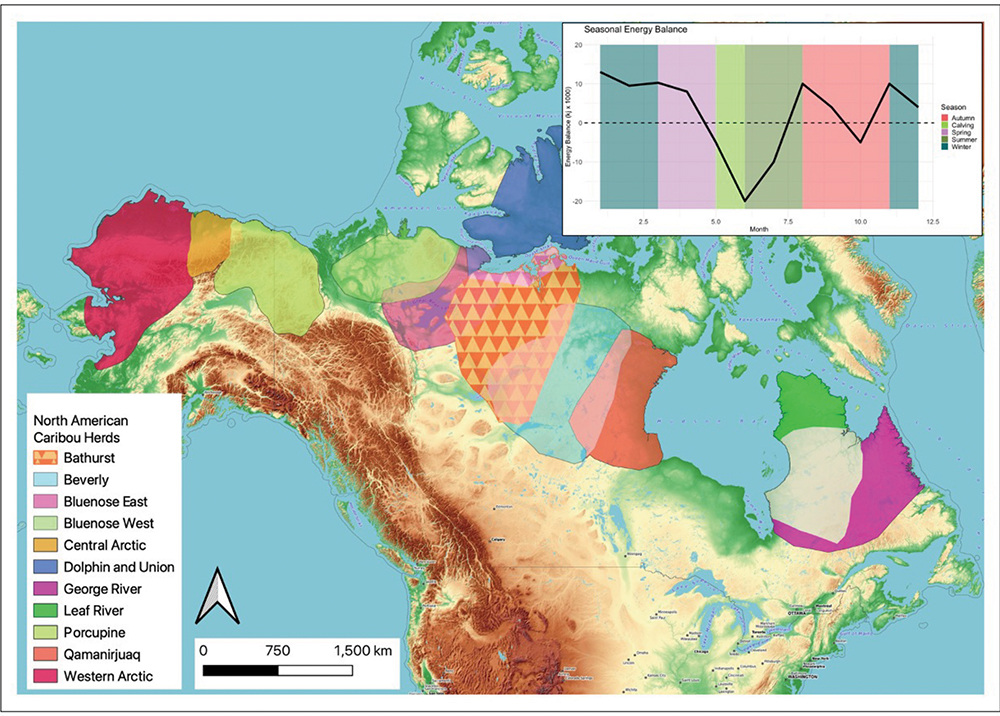
Big game species like ungulates have captured the imaginations of humans for tens, if not hundreds, of thousands of years. From the artists of the Lascaux Caves to modern hunters and naturalists, humans are drawn to their beauty, spectacle, and thrill of the chase. In North America, caribou stand apart as one of the continent’s most charismatic yet underappreciated ungulates—one that is uniquely suited for extremes. From the mountains of the Canadian Rockies in the south to the furthest northern reaches of the Arctic Archipelago, caribou (which are North American counterparts to Eurasia’s reindeer; both are subspecies of Rangifer tarandus) make their living in some of the most extreme resource-poor habitat, especially migratory barren-ground and island-dwelling subspecies.
Herds of barren-ground caribou withstand long winters with temperatures routinely as low as -70 degrees Celsius. Their seasonal migrations amount to more than 1000 km each year. Caribou migrations across the landscape have thoroughly transformed and maintained the ecology and culture of the region. By foraging and moving nutrients across the tundra, caribou have helped to maintain plant diversity and have been integral to the survival and culture of Indigenous peoples for 10,000 years.
And yet, despite having survived ice ages, glaciations, and mass extinctions, the future of North America’s caribou is uncertain as changing climate alters parasite dynamics, pushing caribou to their limits. Indigenous peoples and Western researchers search for answers as barren-ground caribou populations decline across the North. As a postdoctoral research scientist at the University of Calgary, I worked alongside Indigenous communities and government management agencies in Canada’s Northwest Territories to try and understand how the combined impacts of insect harassment, parasites, and changing forage quality may have contributed to declines in what was once Canada’s largest herd.
Caribou azre likely to be in trough shape lgooing forward.
A lot has changed since my grandmother saw them migrate down off the hilll in the 1800s. Those are long gone and not coming back.
The Beverly caribou herd has shown a significant population increase, growing from 103,400 animals in 2018 to an estimated 152,000 in 2023. This is average 10,000 caribou more per year so in 2026 this Beverly caribou herd should be 183,000 head. This reversal follows a long-term decline since the 1990s, driven by high calf survival and increased adult female numbers. The herd, which spans the NWT and Nunavut, is showing promising signs of recovery.Key Population Growth Findings (as of 2025/2026):Recent Growth: Data from 2023 indicates an ~8% annual increase, marking a strong recovery from the 2018 low of 103,400, up from 276,000 in 1994.Surprising Comeback: Officials from the BQCMB noted the increase in adult females from 61,070 in 2018 to over 88,000 in 2023 is “surprising” and a “good news story”.Causes for Growth: Potential drivers include healthy calf recruitment (nearly 70,000 breeding females in 2023), favorable foraging conditions, and shifts in natural predation patterns. Canadian Wildlife Adventures