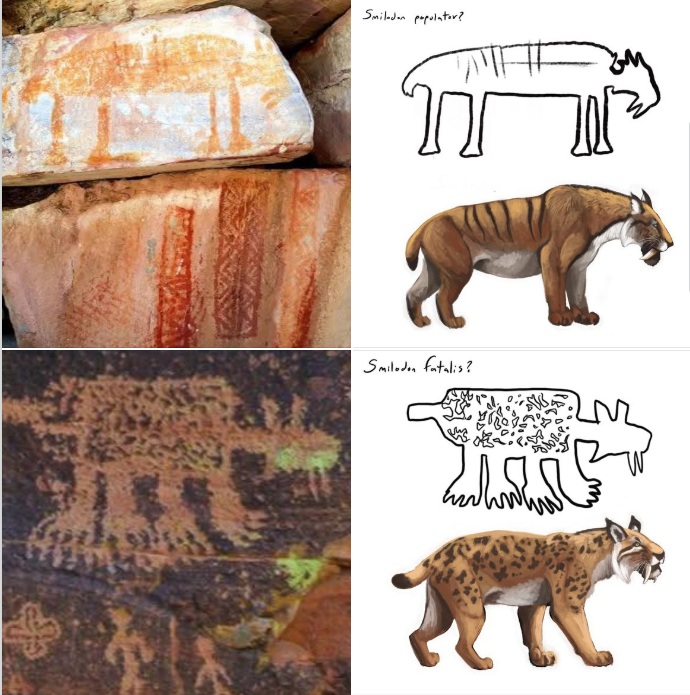
Folks been sending me a photo of a petroglyph (rock art) apparently found in Bahia, Brazil; it shows what at first glance could be interpreted as some sort of mammal with what might be long fangs or tusks pointing downwards, short pointed ears (?), a short tail, and what may or may not be vertical stripes running down from its back.
Is this, perhaps, a prehistoric human’s portrayal of the fearsome Smilodon populator, the top cat in South America during the late Pleistocene?The apparent lack of sabercat depictions has baffled us for a long time- seeing as at least two genera (Smilodon and Homotherium) are believed to have coexisted with humans during the late Pleistocene, one would expect these creatures to have left a deep impression in our forebear’s minds, yet precious few depictions have been suggested as potential sabercats.This Brazilian petroglyph, if genuinly prehistoric, is very interesting to compare with another found in Arizona, which also seems to portray a catlike animal with a short tail and long protruding fangs.Although some people have suggested the Arizona petroglyph might in fact depict a bobcat, the “fangs” are a peculiar aspect of it, although one could argue that its paws/claws are also portrayed as disproportionately huge, perhaps to stress the danger of the animal’s natural weapons.If these two were indeed Smilodon, they would likely represent two separate species; the North American late Pleistocene Smilodon belonged to the species fatalis, which was about the size of modern lions and tigers, although with very different proportions, whereas the Brazilian one would be the much larger populator.Curiously, and despite the very simplified style, I compared both to the silhouette of populator and fatalis and they seem to fit nicely in general terms. If these were indeed Smilo, they’d suggest fatalis had a spotted coat, bigger ears and perhaps some sort of ruff, like lynxes and tigers, whereas populator would have smaller ears (expected from a much larger cat) and maybe stripes. Keep in mind both species are now known to have coexisted in South America as well!
Tantalizing stuff :B I sure hope these are legit!
Very cool, if true?
Saw skulls found in Colorado at museum. Truly impressive…. Glad I wasn’t around then. But I really love reading about them.
But the art work is spectacular.. thanks steve