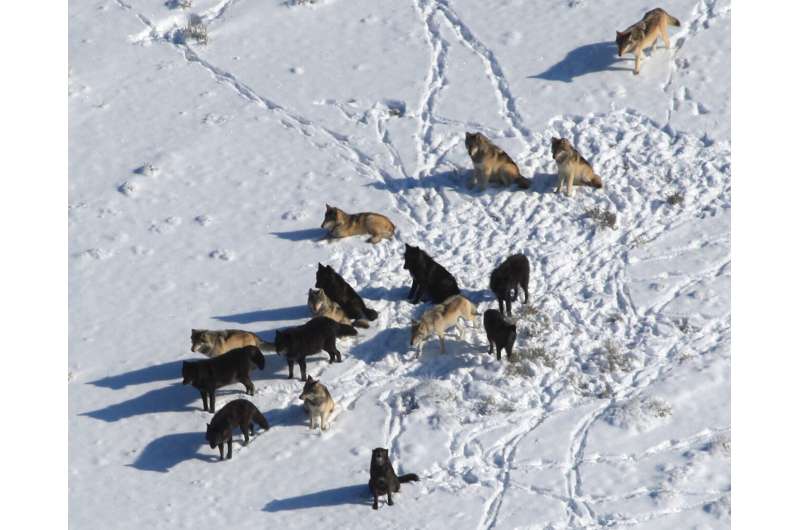
Coat color in wolves (Canis lupus) is determined by a gene called CPD103. Depending on the variant of the gene a wolf has, its coat can either be black or gray.
The researchers postulated that this gene also plays a role in protecting against respiratory diseases such as canine distemper virus (CDV). This is because the DNA region containing the gene also encodes for a protein that plays a role in defending against infections in the lungs of mammals. They predicted that having a black coat would be associated with the ability of wolves to survive an infection with CDV.
I heard wolf color was caused by recessive genes from dogs. This is a big departure from that.
If you were to travel from Arctic Canada and head south down the Rocky Mountains into the U.S. toward Mexico, the further south you go, the more black wolves there are. The reasons why have long puzzled scientists.
Wolves in the Southwest tend to be more black.
No, it is not a departure from the introgression of the dog CPD103 allele. The long story short is that the very paper discussing the selective advantage of the black variant CPD103 locus points out that this variant comes from introgression from dogs.
The long story long is that natural selection acts on the genetic variation that exists in the world, not the Platonic image of the world. It does not matter where a genetic variant comes from, once it is acting in an organism it is subject to selection. Said variant must come from somewhere, either from a natural mutation in the organism in question, or from a natural mutation that originates in one of the ancestors of said organism. So there is no discrepancy whatsoever between a genetic variant coming into a wild population from accidental mating with individuals (or, just one individual) from a different (in our case, domesticated) population, and this very variant having a selective effect in this wild population. This is because the history of a genetic variant and the current selective effect of it are two different things.
Thanks for the deeper dive. Frankly, I am amazed anyone is reading my posts.
Red vs. Grey
Eastern screech owls come in two basic colour forms, red and grey. Distribution varies geographically: Red owls predominate toward the south and east, and grey further west and north. It has been suggested that grey makes for better camouflage in hardwood forests, and red where pines and hardwoods mix (or in more humid forests), but I read somewhere that the red owls are also more physiologically intolerant of cold. Steve may remember more about this than I.
Yes, like ruffed grouse. They have the same, or similar pattern. It is mostly grays here and brown ones further south. I have heard theories but I am not sure if any are definitive.