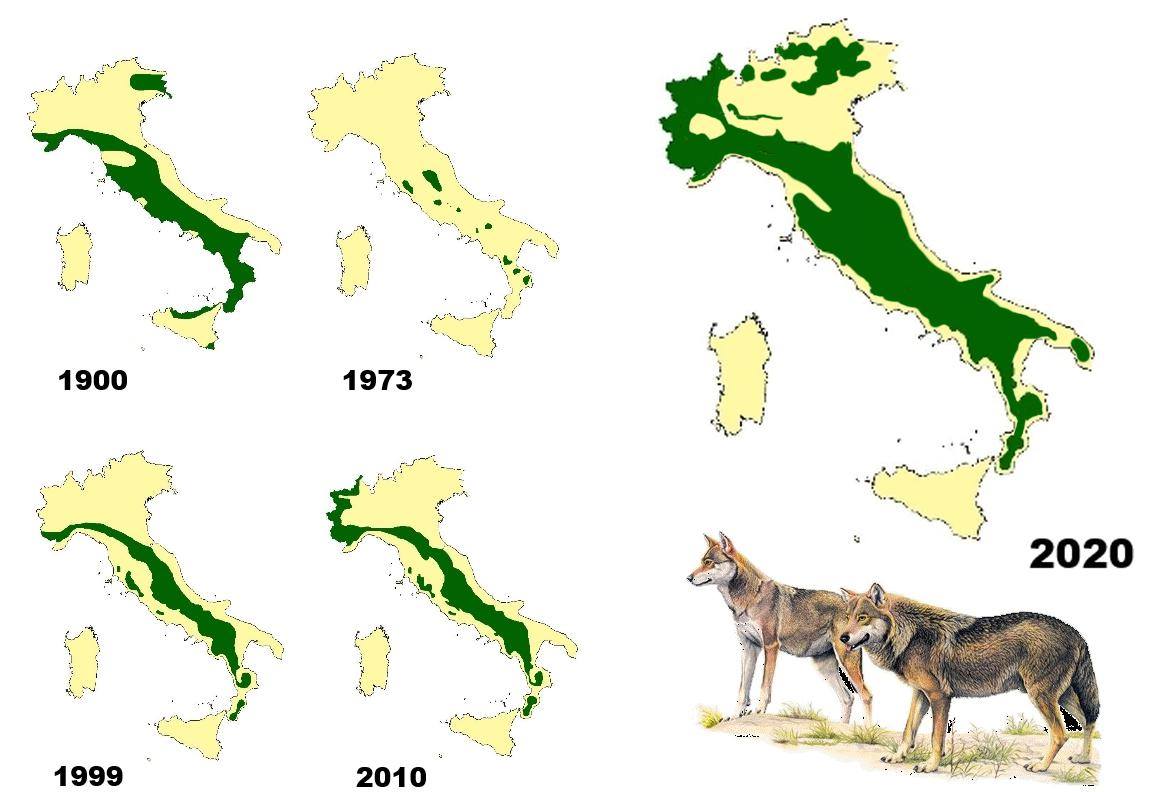
This subspecies is not universally accepted by all specialists, as is the case with the Iberian wolf ( C. l. signatus, defined by Cabrera in 1907), but recently (2010) mitochondrial DNA studies have been carried out in Italian wolves that have yielded amazing results. It appears that two haplogroups (or mitochondrial genetic lineages) have been defined for western European wolf populations. Haplogroup 2 was the dominant one in western wolves for the last 40,000 years before the Last Glacial Maximum, and only a few thousand years ago it was replaced by haplogroup 1, today the dominant one, not only in Europe but also in North America.
Well, italic wolves were found to still maintain the old haplogroup 2, which they shared with Japanese wolves ( C. l. hodophylax ). After the extermination of the Japanese wolf, the Italian wolf is the only subspecies of wolf that maintains haplogroup 2, which means that they are the last representatives of Pleistocene wolves that took refuge in the Mediterranean peninsulas during the harshest part of the last ice age. and they were able to remain genetically “pure” by virtue of the geographical isolation of the Italian Peninsula, closed to Europe by the arc of the Alps, which made genetic exchange with continental wolves difficult. Therefore, the character of a subspecies of the Italian wolf would proceed, or at least the recognition of a unique and valuable genetic specificity.
From the Apennines to the Alps. The epic of the Italian wolf.
A well written post with news that surprised me on Euro wolves.
Some prior posts on Euro wolves.
I am still surprised at how wolves are colonizing European. Wolves in North America seem unable to replicate what they are doing. It may be behavioral with Euro wolves more like coyotes than wolves here. Wolves are complex it seems and I haven’t kept up. I am not into wolves much.
To the best of my understanding ravens in the US are much more likely to associate with people than European ravens. We have quite a lot here (South central Finland) but they do not seem that keen to be around people and buildings in the least. So the ability or willingness of a species to be in proximity with people is quite varied across its range. Brown bears (i.e. grizzlies) in South Eastern Europe are also quite comfortable around people apparently (I do not expect a Finnish bear to come in the garden if I were to keep bees, I would not be that sure in Romania).
I said it before here, and I say it again, once people stopped actively killing them, and killing them as collateral bycatch, wolves could only increase in Italy. By and large there is not enough active and direct drive in killing them off, and nobody really cares that much (pitbulls used for illegal fighting are way way more of a danger and a concern than wolves mind their own business). There are other issues, such as an insane number of herbivores everywhere, causing a lot of damages to crops (I have seen fields fenced with electric fencing to keep deer and boars out — I doubt the farmer would be that hostile to wolves, especially because he had no livestock).
I personally know of a man who ended up making pizza in London (UK) after being a shepherd for years — he lost all his flock to blue tongue disease. Wolves? not a big deal. I also know smallholders who kept goats — until they were reminded that they had to do some brucellosis related work (which is expensive) — no more goats. Wolves? again not the issue. Socio-economical, and ecological reasons drive the resurgence of predators in Europe, and that is not gonna change anytime soon.
How the west was won: genetic reconstruction of rapid wolf recolonization into Germany’s anthropogenic landscapes