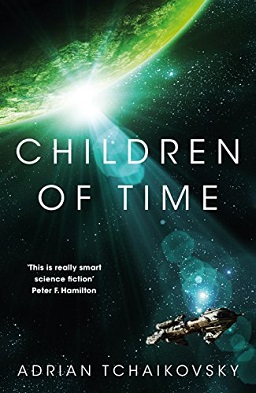
In the far future, Dr. Avrana Kern is the head of a science team orbiting a terraformed, previously uninhabitable exoplanet that she hopes will be named “Kern’s World.” The team is preparing to release a genetically designed nanovirus onto the new world to accelerate the evolution of a group of monkeys. There is talk of war stirring back home between authorities and multiple anti-technology factions opposed to this kind of genetic engineering, including a terrorist group or radical movement known as “non ultra natura” (nothing greater than nature).
Dr. Kern learns there is an agent of an anti-technology group aboard the ship about to overload the reactor, and she flees aboard an escape pod before anyone else can. The payload of monkeys is jettisoned from the ship in a landing craft but it burns up in atmospheric entry. With no monkeys on Kern’s World, and its ecosystems originally seeded with a minimum of possible competitor species for Kern’s experiment, the nanovirus spends its time infecting and altering a multitude of living creatures, a notable example being jumping spiders (Portia labiata)—referred to in the book as Portiids. Dr. Avrana Kern is left stranded in orbit awaiting rescue, periodically waking from stasis, troubled by the sudden cessation of radio signals bleeding out from humanity’s home.
Many millennia pass, and civilization reemerges on Earth from the hunter-gathering descendants of survivors, eventually salvaging machinery leftover from Kern’s time, which is only known as the Old Empire. Faced with the slow collapse of Earth’s biosphere due to the long-delayed consequences of the ancient war, the last remnants of humanity are en route to Kern’s World aboard the starship Gilgamesh, hoping for a paradisiacal planet and ignorant of the uplifted Portiid spiders. Confronting Dr. Avrana Kern in orbit, powerful and rendered crazed and xenophobic by the millennia, the Gilgamesh takes a centuries-long detour to a neighboring system that proves uninhabitable. The novel plays off the contrast between the rapid advancement of the spiders’ societies and the descent of the crew of last humans into strife and barbarism, primarily seen through the eyes of the Gilgamesh’s chief classicist, Holsten Mason.
After the Gilgamesh returns to Kern’s World, the two narratives collide, seemingly dooming one or both sides to extinction. The Portiids, on the other hand, devise a strategy that saves both their world and the invaders, uniting with and inviting the last humans to live with them on Kern’s World, drawing on past genetic memories, known as “Understandings,” which showed collaboration was the better option in the end.
I went down to the coast and visited my physicist friend. He mentioned he read this book. It sounds like a good one. 40K 5 star reviews on the river site.
Has anyone read it?
Steve may have since he is into sci fi.
Six pages of science fiction posts mostly by Steve.