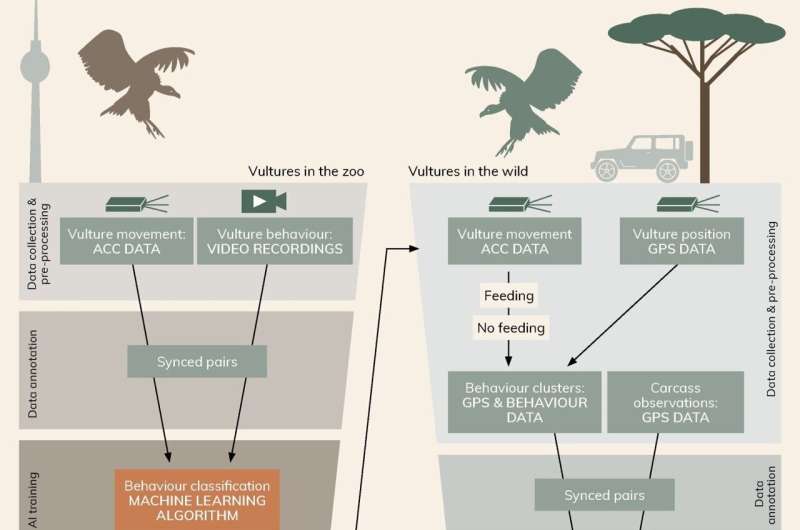
Vultures are perfectly adapted by millions of years of evolution to detect carcasses across vast landscapes quickly and reliably. They have outstanding eye-vision and sophisticated communication that allows them to monitor very large areas of land when many individuals work together. Vultures thus fulfill an important ecological role by cleaning landscapes of carrion and containing the spread of wildlife diseases.
“The GAIA field scientists and their partners in the field were able to verify more than 500 of suspected carcass locations derived from the sensor data, as well as more than 1300 clusters of other non-carcass behaviors,” says Aschenborn.
“We could predict carcass locations with an impressive 92% probability and so demonstrated that a system which combines vulture behavior, animal tags and AI is very useful for large-scale monitoring of animal mortality,” says Aschenborn.
This AI-based behavior classification, carcass detection and carcass localization are key components of the GAIA early warning system for critical changes or incidents in the environment.
I love this combo. I can see it opening other possibilities as well. I am guessing it will migrate to California condors soon.
Steve as a fan of vultures likely approves as well.