In 2005, an ecologist named Crow White drove to 12 locations inside an elk hunting zone in Jackson Hole, Wyoming, and fired a .30-06 rifle into the air. Before each shot, he counted every raven within 100 meters. Then he pulled the trigger, waited ten minutes, and counted again. On different days at those same spots, he ran the exact same test using an air horn, a whistle, or silence.
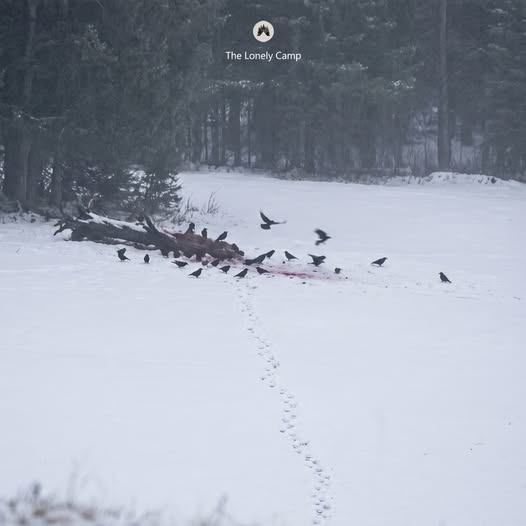
The ravens only came to the rifle shot. They ignored the air horn, the whistle, and the quiet controls. Even more telling, they only flew to the gunshot when White fired inside heavy timber. When he shot in open meadows, where a dead elk and drag marks in the snow are easy to spot from the sky, the birds did not bother reacting to the noise. They only tracked the gunshot into thick forest canopy, where their eyes could not find a carcass and the sound was the only way to pinpoint the meal.White published his findings in the journal *Ecology*, marking the first hard proof of a wild scavenger actively homing in on gunshots. The birds were not trailing hunters or stumbling across gut piles hours later. They were using the report of a high-powered rifle in real time to locate meat before the elk was even field dressed.Biologists call the mechanism second-order conditioning. For thousands of years, ravens have shadowed wolf packs, often circling overhead while the chase is still happening and landing on the carcass while it is still warm. When wolves were reintroduced to Yellowstone in 1995, ravens adapted to the returned predators immediately. White suggested that the birds simply applied that old evolutionary habit to human hunters. Wolves kill elk and leave scraps. Men in orange vests do the exact same thing, except a rifle gives off an acoustic beacon you can hear two miles down a canyon.The sheer volume of food involved explains why ravens learned the trick so fast. A separate UC Berkeley study led by Christopher Wilmers tracked scavengers along Yellowstone’s northern border during the six-week winter elk hunt near Gardiner, Montana. Over the entire six-month winter from November to May, wolves left roughly 29,000 pounds of carrion on the landscape. In just six weeks, elk hunters left 73,000 pounds of gut piles packed into a single drainage.A wolf kill drew an average of 36 ravens and fed 12 different scavenger species. A hunter gut pile drew an average of 78 ravens, while almost everything else stayed away. Coyotes were common on wolf kills, yet avoided hunter gut piles entirely because hunters outside the park shoot coyotes on sight. Ravens are federally protected and rarely shot at, so they learned to fly straight toward the muzzle blast.Wilmers noted that concentrating 73,000 pounds of offal in one valley creates a massive, localized spike in raven numbers. When hunting season ends and the gut piles disappear, those hundreds of extra birds do not just vanish. In areas bordering sage-grouse habitat, the ravens that gathered for winter elk meat stick around into spring and switch directly to raiding grouse nests.Image is for illustration purposes only.
Source: White (2005), Ecology / Wilmers et al. (2003), Ecology Letters / University of California, Berkeley / Stahler et al. (2002), Animal Behaviour.
I am not surprised. They were a constant presence during deer season. They miss nothing. The sounds they make are so iconic during that time.