Since this is my first official post, let me provide a short introduction: I’m a sheep rancher, writer/photographer from western Wyoming who is fascinated by animals of all sorts, and by the humans who interact with them. I’ll leave out the details of my journey to get to Mongolia, but delve right into some of the highlights once I left Olgii and headed out into the countryside during the first week of October.
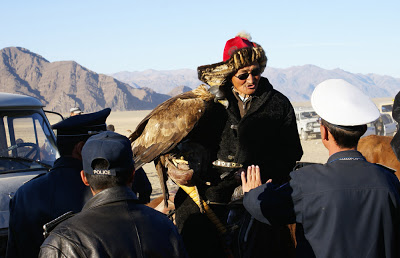 The judges jumped into the van next to the stand, and I watched as one pissed-off hunter took off after them, attempting to block the van from leaving (on horseback, with his eagle), smacking the top of the van with his horsewhip. I started shooting photos, from my overlook on top of the bench, as the hunter argued with the police. As it was ending, I took one last shot, only to have one of the policemen turn around and look right at me. I turned away really fast, jumped off the bench and tried to get away, but when I started out through the crowd, I felt a hand grab my arm and spin me around. It was the policeman, saying something I couldn’t understand, but really upset. I gave him the big eyes, “I’m sorry, I don’t understand,” and that made him say, “I’m sorry” as well. We continued going rounds until some good soul, a Kazakh horseman, came up and intervened, telling me “police photos are very sensitive” as the cop continued to point at my camera. I walked them through a few of my photos, deleting them one by one as the cop watched. I then switched back through the photos in the other direction, so it appeared there were no more photos of the cop and the dispute. The policeman calmed down as I said “delete” each time, and seemed satisfied that I didn’t have any more sensitive photos. The very tall policeman was actually very nice, and seemed as relieved to be out of the situation as I was.
Our next stop was at the top of a big hill. We had raced the other vehicle up the hill from the valley below. We were told there was a slight problem with the vehicle. It took two vehicles of Kazakh men, but eventually they fixed the problem underneath our van with a roll of wide scotch tape.
As we journeyed forth those first few hours, we stopped occasionally to meet up with the other truck and have a drink. Our eagle hunters were charming, breaking out into song as we drove, and the tone was that of a western ballad. It was wonderful and we teased them about it.
The other group eventually went another way, and we went ours, only to get lost in the dark, in the wild steppes of Mongolia. It took many hours, but we eventually pulled into a yard with goats and a barking ger dog. We got out and went into the most beautifully decorated Kazakh ger. It was huge. Kazna, Aralbai’s wife, greeted us as we entered.
Kazna prepared a communal feast, with everyone gathered around the large platter of meat, eating with their hands, knocking bones together to get the marrow. We drank Kazakh tea, and when they broke out the vodka after dinner, I had a sip and went to bed. These are warm, generous people, and very gracious hosts.
Cat (and Steve) did you get a sense of what exactly the eagles and falconers were being scored on?
Matt, we were told they were being judged on how quickly the birds flew once they were called, whether they flew straight to the fist or lure, and whether they landed on the fist or lure.
Pretty straightforward. We have at least one “competitive event” in American falconry (the Sky Trials), which are somewhat analogous to pointing dog trials; but these are marginal in the big picture.
We do have something like a falconers’ festival, too—the annual North American Falconers Association meet, usually in the Great Plains. In recent years, an eagle group has also formed, and they hold their own annual meeting—Steve’s young friend Lauren has attended and written about it for one of our falconry magazines.
Eagle falconry, in this country, is in its infancy. But considering the big spaces and perfect game avaialble, there is room for growth.