It’s a long but important read.
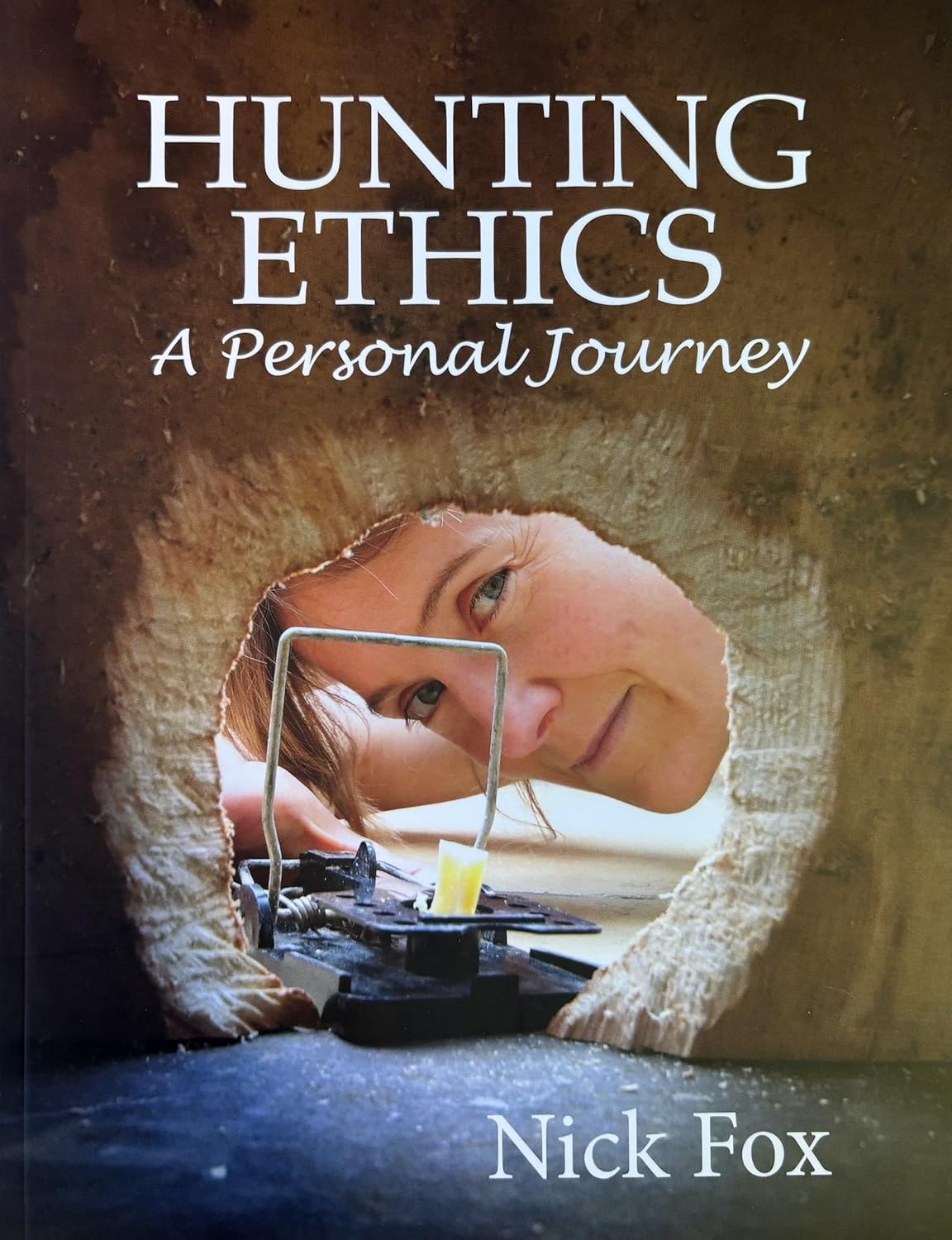
“I am currently reading Hunting Ethics: A Personal Journey by Nick Fox.
I’ve known Nick since I was a teenager—or, as he would say, a spotty-faced teenager. Reading this book feels like having a conversation with the Nick I knew as a student of falconry and ecology, and as a young man often in awe of his independent and unique outlook on life.
It is a remarkable and brutally honest book. It is, in part, a personal account of Nick’s journey through life, but it is also much more than a book about hunting—a title that, unfortunately, might deter some from picking it up.
Nick is a rare person these days. He lives in the Welsh countryside and is deeply rooted in rural traditions. More importantly, he understands the balance of nature and the biodiversity crisis we are facing. He farms in a traditional sense, raising sheep and leasing land to local dairy farmers, but he also farms falcons commercially. He produces much of his own food and is unafraid of the realities of farm-to-fork—dispatching the animals he raises and filling his freezers with sheep he has bred and game he has hunted.
His success in breeding falcons has allowed him to purchase and restore tired, over-exploited, and nature-depleted Welsh dairy farms. He has transformed these landscapes by planting trees, restoring orchards, and introducing beavers and other lost species. His love for the countryside and its traditions runs deep, and this book is, naturally, focused on hunting. As one of the foremost British falconers and falcon breeders, Nick has pioneered many commercial breeding methods and worked with a wide range of people—from conservationists in Central Asia to Arab sheikhs in the Middle East and beyond. Many people breeding falcons commercially in the UK and abroad worked with Nick at various stages in their careers and took what they learnt to start successful businesses. Unlike Nick, very few, if any have ‘reinvested’ the money that they have made back into the natural world which is a shame.
The book covers Nick’s journey, with chapters on behavior, different types of hunting, and the motivations behind it. It explores welfare issues, morality, ethical values, species conservation, and the impact of humans on habitats—both locally and globally. Despite its title, this book is not just for hunters; it is a fascinating examination of human life itself.
I doubt many readers will agree with everything in this book. It is a book that will challenge your perspectives. Speaking from my own experience, I practiced falconry as a young man, worked in falcon hospitals, and kept ferrets. I even used to shoot but, apart from culling grey squirrels around my smallholding these days, I no longer hunt. While I keep and kill my own sheep to feed my family, I can no longer justify hunting or killing wildlife in an age of massive biodiversity loss. Instead, I focus on conserving what little wildlife remains. This is likely where I differ from Nick, who still hunts in a low-impact way, yet his contribution to rewilding in Wales is undeniable or as we would say in local Welsh parlance ‘MASSIVE!’.
I greatly admire Nick’s work in rewilding these once wildlife-depleted dairy farms. Today, his farms are home to lakes, beavers, and woodlands—a remarkable transformation. Nick is a man of action, someone who does not just talk about change but actively makes it happen.
This book challenges the reader to reconsider their own impact on the natural world. Even those who do not consider themselves hunters will find new perspectives on how they interact with nature. And for those who believe they are exempt from harming wildlife—vegans included—this book is a sobering reminder that simply by existing, we displace other species. That is the reality of nature and just living.
One of the book’s greatest strengths is its raw honesty about the human relationship with the natural world. It lays bare the hypocrisies we all carry—whether in our views on nature, the things we say but do not do, or the attitudes we have not fully or honestly examined. I suspect this book may come to be regarded as an important marker of where humanity stands in its relationship with nature in the UK in this century.
For those familiar with Nick, the book is full of what I would call ‘Nickisms’—sharp observations on human behavior drawn from the animal kingdom. Some of these may irritate readers, as Nick is unafraid to poke fun at modern life or challenge religion, one of his long-standing bugbears. But those who have worked with him will know that he has always been one to be unafraid of poking a stick down a wasp nest and seeing what happens. Some may find these views offensive, but they stem from Nick’s perspective as a biologist—seeing humans as animals and analyzing our behaviors as he would those of a breeding pair of falcons. His observations, though sometimes uncomfortable, often contain undeniable truths.
For falconry enthusiasts, there is much to learn about the hunting behaviors of different birds of prey. But this book is not just about falconry; it is also an exploration of human behavior, from birth and learning to how communities form and nations arise.
Nick has a remarkable ability to strip away the veneer of civilization and expose the core mechanisms that drive human behavior—how we eat, think, love, ‘breed’, and cooperate. On one level, this makes for a fascinating read. On another, it is a bleak and unsettling book. As a disciple of Richard Dawkins and the selfish gene theory, Nick attributes much of human behavior to the survival of genetic material. This perspective offers an explanation for many of the darker aspects of our world—war, ethnic cleansing, and the ascendence of the selfish and greedy in positions of power.
This is where I personally struggle with the book. As a Christian—albeit not a particularly devout one—I find Nick’s reductionist view of human behavior challenging. I try to follow the teachings of Jesus, another remarkable man, as best I can. While I acknowledge the biological instincts that drive us, I also believe in something greater—something that gives meaning beyond mere genetic survival. Perhaps I am just weak and need the reassurance of ‘hope’.
This book forces the reader to confront uncomfortable truths—not just about the world, but about themselves. It is not always an easy place to be, but it is important to ask difficult questions of ourselves. Nick understands the power of cooperative rituals and behaviours in binding groups together. Ultimately, he sees religion as just another story—a fiction that societies tell themselves to maintain cohesion. This is an unsettling notion for those of us who follow faith traditions, but it is one of many thought-provoking ideas this book presents.
I am only halfway through, and I wonder what more I will discover. But already, Hunting Ethics: A Personal Journey has made me reflect deeply—not just on my relationship with the countryside and nature, but also on my own motivations. That, I think, is the mark of an important book. I hope this book gets the wider audience that it surely deserves.
I have now finished a back-to-back reading of The Hunting Ethic: A Personal Journey by Nick Fox. I thoroughly enjoyed it—not just for its content but because having known Nick for many years, I found it fascinating to read his thoughts on such a wide range of topics, some familiar and others out of my usual reading menu. His analysis of his own ‘life’ decisions, including his time in the school sanitorium as a young boy adds further depth, offering insight into the thought processes behind his choices.
The book covers a broad spectrum of topics, from the ballistics of shooting foxes and the effectiveness of different control methods for pests and hunted species to deeper ethical and philosophical questions. The sections on animal welfare, particularly the ballistics of shooting and target analyses, are weightier and require careful attention, but they are thought-provoking and well worth the effort.
Nick has taken care to write a highly readable text without excessive scientific jargon, making the book really accessible to a wider range of readers. One of my critiques is the lack of labelled images and tables, with references to them often unclear in the text. A future edition would benefit from proper indexing (e.g. I could not find commons / tragedy of the commons in the index) and more explanation of data in tables and graphs, as Nick assumes a level of familiarity that may not be shared by all readers.
A particularly fascinating aspect of the book is Nick’s forensic approach to problem-solving. Rather than accepting second-hand facts, he tests theories himself. His investigation into shooting accuracy, for instance, involved freezing a dead fox, sawing it in half and marking out its organs, and creating shooting targets to assess how different firearms and distances impact lethal effectiveness. This hands-on methodology is characteristic of how he approaches many challenges in life.
Despite its title, this book deserves a wider audience beyond those directly involved in hunting. It would be unfortunate if non-hunters—especially vegetarians or vegans—dismissed it outright, as Nick’s discussion of morality, ethics, wildlife management and how we ‘feed’ ourselves extends far beyond hunting itself. He examines how we humans organize societies, form groups, and develop ethical frameworks. His moral mapping of human behaviour is particularly compelling, bringing abstract concepts down to the realities of farm life, where life-and-death decisions are made daily—realities often far removed from modern urban and even rural existence.
Nick does not shy away from difficult topics. He applies the same scientific rigor to human territorial behaviour as he does to bird of prey home ranges, drawing parallels between national conflicts and animal instincts. His perspectives on euthanasia—whether of elderly beloved horses, livestock kept for food production, or injured wildlife—are pragmatic and challenge conventional thinking. He also highlights societal contradictions, particularly the bureaucratic hurdles surrounding the reintroduction of native species like beavers, while non-native species like pheasants are released in vast numbers with little regulation.
The book touches on many urgent global issues, including biodiversity loss, climate change, and political inaction. Nick critiques the way our species prioritizes anthropogenic concerns, arguing that our evolutionary instincts—favouring the individual, family, tribe, and immediate interests—may be the root cause of our failure to address planetary crises. He suggests we must rethink our political priorities, yet he remains skeptical that we can overcome these deeply ingrained tendencies.
The final chapters are particularly eye-opening, as Nick reflects on his experiences with conservation projects around the world. He exposes the corruption, cultural straight-jacketing and bureaucracy that often hinder progress abroad and in the UK, illustrating how our systems frequently make restoring nature unnecessarily difficult. His discussion of threats to biodiversity includes the devastating impact of free-roaming pet cats in the UK on wildlife, as well as the unintended consequences of veterinary antiparasitic treatments on companion and production animals, of which there is mounting evidence that these drugs are accumulating in the environment and are contributing to the alarming decline of invertebrate populations—a modern Silent Spring.
So why read this book? First and foremost, because it is deeply thought-provoking. If you have any interest in nature, wildlife management, or understanding the instincts and behaviours that drive us, this book will tickle your intellect and challenge your perspectives.
Nick is not trying to convert readers to his way of thinking—indeed, he strongly objects to dogmatic belief systems—but he will make you question assumptions you may not have realized you held.
He also offers practical insights into rewilding and conservation, based on his own work restoring nature-depleted former dairy farms. He discusses the challenges of selecting species, planting trees, and experimenting to see what works—acknowledging that there is no single formula for success. His approach is refreshingly honest: conservation is messy, full of trial and error, but necessary.
Another area where I believe the book could be improved is in its discussion of access to the countryside. Nick is dismissive of Guy Shrubsole’s arguments for greater public access to land, yet I think he would benefit from reading Shrubsole’s The Lie of the Land, which critiques how land ownership and industrial farming have contributed to the UK’s biodiversity crisis while disconnecting so many people from nature. The book could also take a more critical view of farming’s role in environmental decline—after all, if farmers are the self-proclaimed guardians of the countryside, why is so little nature left? Perhaps this is where Nick needs to be more critical of his own ‘tribe’?!
To conclude, I’ll borrow words from Wendell Berry, whose wisdom on food, farming, and sustainability feels particularly relevant:
“I would like to conclude by confronting directly the issue of hope. My hope is most seriously challenged by the fact of the decline, of loss. The things that I have tried to defend are less numerous and worse off now than when I started, but in this I am only like all other conservationists. All of us have been fighting a battle that on average we are losing and I doubt that there is any use in reviewing the statistical proofs. The point – the only interesting point – is that we have not quit. Ours is it not a fight that you can stay in very long if you look on victory as a sign of triumph or on loss as a sign of defeat. We have not quit because we are not hopeless. My own aim is not hopelessness. I’m not looking for reasons to give up. I’m looking for reasons to keep on.”
At times, Nick’s book is profoundly disturbing, forcing us to confront the evolutionary trap our species has fallen into. But within its pages, there are also seeds of hope that those of us who care about the state of Nature so desperately need. While political systems may ignore uncomfortable truths—such as human overpopulation—Nick and the wider rewilding movement demonstrate that it is possible to restore landscapes and ecosystems. The success of projects like the Knepp Estate shows that change is achievable.
Perhaps the highest praise I can offer is that this book should be compulsory reading for anyone who aspires to govern. Certainly in the United Kingdom that should include anyone working for our department of environment and agriculture before they dare think of tinkering with regulations.
So I congratulate Nick, The Hunting Ethic is a gem of a book that makes the reader grapple with uncomfortable realities, while offering a vision of what could be achieved if we choose to prioritise nature.”