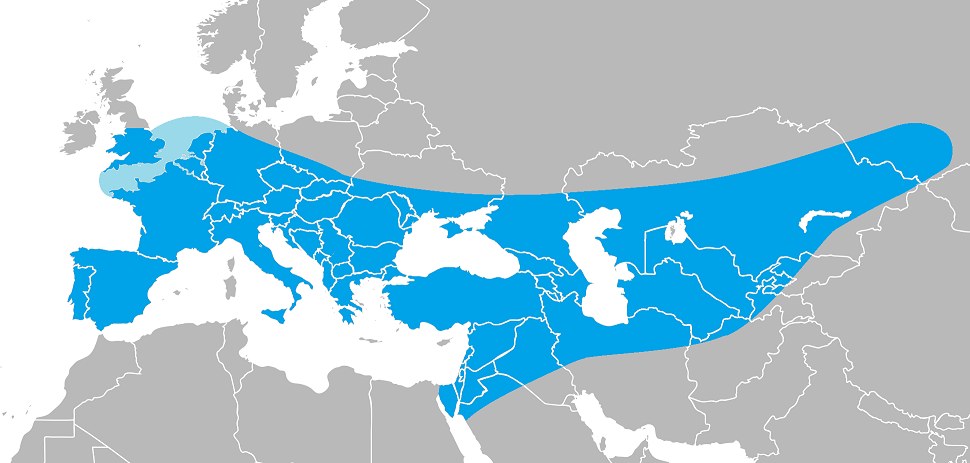
Homo sapiens first tried to leave Africa 100,000 years ago. But Neanderthals with larger brains repelled them from the Levant.
At least six different human species roamed the planet 130,000 years ago. Sapiens were undistinguished.Homo juluensis (Big-headed People), discovered in 2024 in China, was possibly a seventh human species.Others were the Solo Man (discovered in 1931) in Java, “the Hobbit” or Flores Man (discovered in 2003) in Indonesia, Denisovan Man (discovered in 2008) in Siberia, and Callao Man (discovered in 2007) in the Philippines.* * *Neanderthals originated in Eurasia 400,000 years ago and became extinct 40,000 years ago.In 2010, German scientists extracted Neanderthal DNA from a fossil and discovered that Europeans and Asians have 1% to 3% Neanderthal DNA.In 2015, the genomes of the oldest Homo sapien fossils (37,000 to 42,000 years old) in Europe were sequenced. They had 6% to 9% Neanderthal DNA.So it’s technically untrue that Sapiens and Neanderthals were separate species (defined by having no shared fertile offspring).Africans also have 0.3% Neanderthal DNA, possibly from Sapiens returning to Africa from Eurasia 20,000 years ago.* * *In their second attempt, Homo sapiens conquered the Middle East 70,000 years ago.They also conquered Europe 40,000 years ago.Sapiens left Asia 45,000 years ago to occupy Australia and 16,000 years ago to occupy the Americas.* * *The Cognitive Revolution (70,000 to 30,000 years ago) put Sapiens at the top of the food chain.Sapiens were the first to use language for creativity, invention, and planning the future. But what made the Sapien language special?Some argue it was more “supple,” able to encode infinite information with a limited number of sounds.Others claim that Sapiens were uniquely social.They communicated more about humans than prey. Their daily gossip evolved their language. Gossip is our default mode for speaking.“Even today the vast majority of human communication–whether in the form of emails, phone calls or newspaper columns–is gossip,” Sapiens (2011) noted.* * *Sapiens uniquely used language for imagination (fiction, mythology, stories, art, innovation).During the Cognitive Revolution, Sapiens produced boats, lamps, bows and arrows, needles (clothes), and art.Sapiens also invented commerce, religion (myths and gods), and social hierarchies.Other species had no fiction.Fiction organized Sapiens. Fiction enabled the collective cooperation of a larger population. Fiction created countries.Fiction allowed Sapiens to become the largest human population with shared beliefs. Fiction created a belief in gold or money.10,000 years ago, no other human species were left.Sapien conquest had eliminated all others. Not just humans, but also most mammals, and thousands of fauna species.* * *There are two theories why Neanderthals vanished 40,000 years ago.Replacement theory asserts they died off, possibly even through genocide.Assimilation Theory asserts that Neanderthals merged with the larger population of Homo sapiens.Sapiens didn’t just have sex with Neanderthals. 3-6% of Aboriginal Australians and Melanesians have Denisovan DNA.* * *The first human species in Eurasia—long predating Neanderthals—were also the first humans to look like us.They were the first humans to communicate verbally in a proto-language (beyond grunts and visual cues).Originally from Africa, the Upright Man (Homo erectus) survived for two million years and became extinct 108,000 years ago.The last survivors were found in Java. No other human species lasted longer.The Upright Man (discovered in 1891) was the first artist and one of the first chefs.Fire was ignited a million years ago. By 300,000 years ago, fire cooking became ubiquitous.The Upright Man was the first to transport fire. That allowed for mobile light and warmth. The Upright Man was the first to migrate into colder, darker regions with forests and mountains.The Upright Man was also the first hunter, the first human predator, after making the first weapons.The Upright Man first lived throughout Africa outside the East Sahara, before migrating to the Middle East 1.9 million years ago and across Asia, from Georgia to Indonesia.The Upright Man also migrated from Morocco into Iberia (Spain/Portugal).* * *One Upright Man descendant was dubbed the Heidelberg Man (discovered in 1907 in Germany). Heidelberg Man originated in Africa and arrived in Europe 700,000 years ago.Heidelberg Man spread across Europe and reached Asia, but vanished 200,000 years ago.Heidelberg Man (Homo heidelbergensis) is the last common ancestor of Homo sapiens, Neanderthals, and Denisovans.
Heidelberg Man was ancestral to Homo sapiens in Africa, Neanderthals in Europe, and Denisovans in Asia.
I can’t vouch for all details but it seems a summary that is mostly correct.
‘Conquered’ is misused.
The map shows the range of Neanderthals, I assume, but it has no label as such.