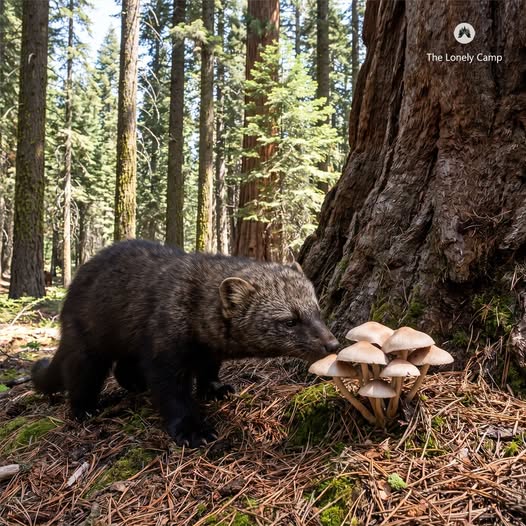
Researchers studying a forest predator known for killing porcupines discovered that nearly half its summer diet was mushrooms. The fisher, an animal famous for dismantling porcupines face-first and pulling muskrats from beaver lodges, was spending its Sierra Nevada summers eating fungi. The paper that documented it called the fisher an unexpected mycophagist. In plain language: nobody expected the porcupine killer to be a mushroom enthusiast.
G. Bradley Smith, Jody Tucker, and Jonathan Pauli published the finding in the Journal of Mammalogy in 2022. They analyzed stable isotopes from hair samples collected during long-term population monitoring of the southern Sierra Nevada fisher, a population so small and so isolated that it has been the subject of federal protection efforts for over a decade. The isotope ratios in the hair recorded what each fisher had been eating during the period the hair was growing. The summer signal was unambiguous. Fungi accounted for 47 percent of estimated dietary biomass. Vertebrates accounted for 14 percent.The numbers flipped everything biologists assumed about fishers. Across the rest of their range, from British Columbia to Minnesota to New England, fishers eat snowshoe hares, squirrels, porcupines, mice, and birds. They are classified as carnivores. Their teeth are built for shearing meat. Their reputation rests on the porcupine kill, a sustained attack lasting up to 30 minutes in which the fisher circles the porcupine, bites its face repeatedly, and eventually flips it to reach the unprotected belly. An animal that does this for a living should not need mushrooms.The Sierra Nevada fishers need mushrooms because the Sierra Nevada does not have what fishers elsewhere eat. Snowshoe hares are rare or absent in the southern Sierra. Porcupines are uncommon. The medium-bodied mammals that sustain fisher populations across the boreal forest barely exist here. What the Sierra Nevada does have is fungi. Truffles, mushrooms, and other fruiting bodies grow through the forest floor in the moist mixed-conifer forests where the fishers live. The fishers found them and ate them because the alternative was starving on a landscape that did not stock the prey they were designed for.The drought made it worse. California’s record drought killed more than half the trees across large areas of the Sierra Nevada between 2012 and 2016. Tree mortality reduced canopy cover, which reduced the squirrel populations that depended on the canopy, which reduced the one significant vertebrate prey the fishers had left. Smith’s team found that during drought, fishers consumed more insects and less plant material, but the fungi stayed constant. The mushrooms were the baseline. Everything else shifted around them.At the Kern Plateau, a perennially dry, high-altitude area at the southeastern edge of fisher range, the isotope data told a different story. Fishers there ate 59 percent vertebrates. They behaved like fishers are supposed to behave. The difference was not the animal. It was the landscape. Where there was prey, fishers ate prey. Where there was no prey, fishers ate mushrooms. The same species, the same teeth, the same evolutionary design for killing porcupines, adapted to the available food so completely that an animal classified as a carnivore was functioning as a fungal forager for half the year.The USFWS noted a troubling correlation: males that consumed higher proportions of fungi had lower survival rates. Whether the fungi caused the mortality or whether both the fungi consumption and the mortality were symptoms of the same underlying problem, a landscape without enough prey, is unresolved. The fishers eating the most mushrooms may simply be the fishers with the least access to the food that keeps them alive.
Source: Smith, Tucker, and Pauli (2022), Journal of Mammalogy / Pilgrim et al. (2023), Forest Ecology and Management / USFWS / U.S. Forest Service.
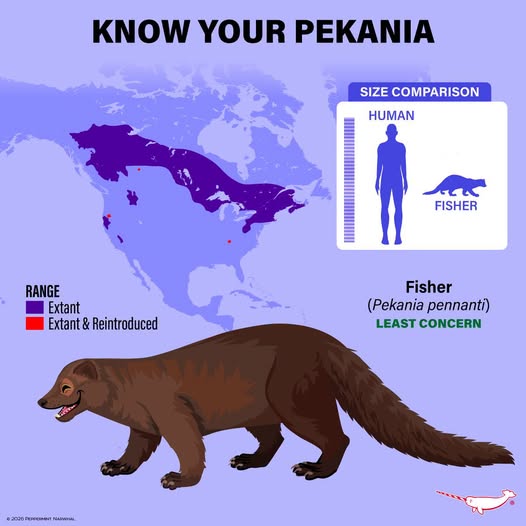
Know Your PekaniaFor years, the Fisher, now (Pekania pennanti) and formerly (Martes pennanti), was placed in the Martes genus. A study from 2008 using DNA sequences discovered that other species of Martes are genetically closer to the wolverine than to the fisher. This finding classifies Martes as paraphyletic. As a result, the fisher was reclassified in the separate genus Pekania. Additional research suggests that the Fisher is more closely related to the Wolverine (Gulo gulo) and the Tayra (Eira barbara) than to martens, further supporting its classification in a distinct genus. So based on all that Pekania now holds the Fisher. It lives a mostly solitary life, roaming a large territory. Im winter, it seeks out a member of the opposite sex to mate. The gestation period is nearly one year, including the time of delayed implantation. A pregnant female gives birth to 1-4 kits, but 2-3 is most common. The Female lives with her kits for a few months in the spring and summer before the young disperse in the early fall to live on their own. The Fisher is an opportunistic omnivore with a wide-ranging diet, but despite its name, fish are rarely eaten and not a significant part of its diet. In the summer, the Fisher is primarily active at night (nocturnal) and during dawn and dusk (crepuscular) but in winter it shifts to hunting during the day (diurnal) to take advantage of warmer daylight hours. It is semi-arboreal which expands its hunting opportunity not just to the forest floor but also within the trees. It will also climb to avoid larger predators. Know Your Pekania
I like Fishers. They are fairly common here but I never see them. I had them on camera a few times and see their tracks.