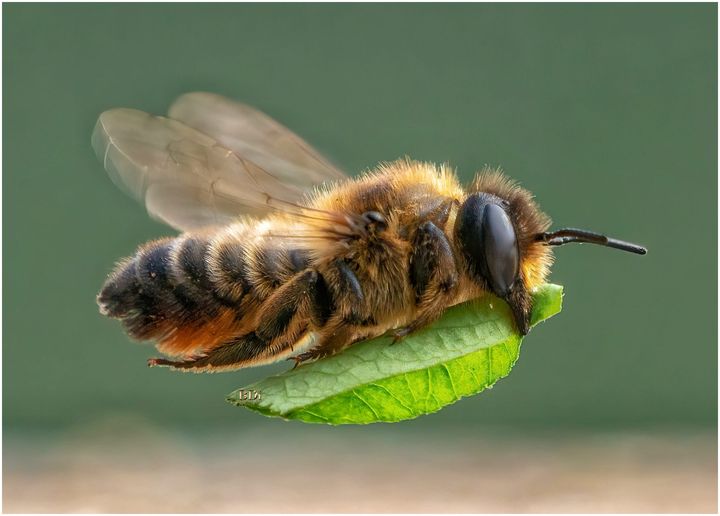
Not exactly perfect macro but seriously close up of a leaf-cutter bee in flight and Possibly one of the most technically challenging photo I’ve ever taken. Sony a7riii Sony 90mm macro lens. Ian Arnold
There are a lot of them and they are cool.
A case in point: bees create and harness electricity and use it as a tool.
When bees fly, the motion of their wings through the air causes them to become positively charged by static… a process called the triboeletric effect. Because the bees are airborne, this static charge accumulates until the bee lands on a flower. As soon as a bee touches down on a flower, however, it becomes “grounded” and the negative charge of the flower’s pollen pulls to the bee like two magnets.
Once a bee lands upon a flower and the respective electric forces are discharged, the flower’s energy field is reduced and it takes time to build back up. A bee’s sensors (antennae and microscopic hairs) are able to differentiate between weakly charged flowers and strongly charged ones, i.e., between flowers that have recently been visited by another bee and those that have not.
Electricity for efficiency — it’s a “bee thang”. The Electric Bee
Steve found a few.
Bee search vs Bees search here.