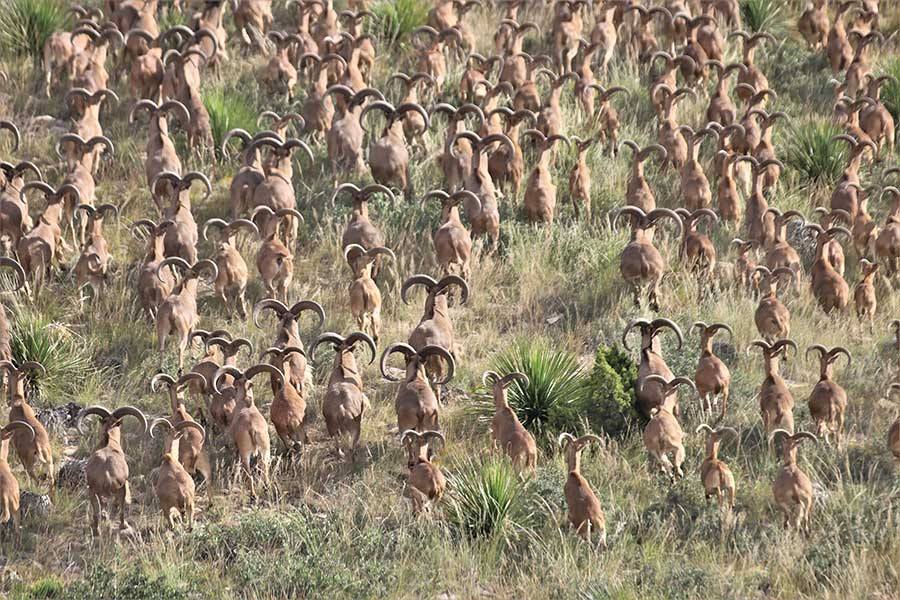
In its native North Africa, the aoudad (or Barbary sheep) is classified as a vulnerable species due to declining numbers. However, in the American Southwest, where it was introduced primarily for hunting, the aoudad population has thrived and is now considered an invasive species. The population explosion of aoudad has had a significant negative impact on native desert bighorn sheep populations.
Introduced to the United States starting in the early 1900s, aoudad are now abundant in parts of Texas and New Mexico, with smaller populations in California, Oklahoma, and Oregon. Their success comes at the expense of native desert bighorn sheep in several ways:Disease transmission: Aoudad can carry and spread the respiratory pathogen Mycoplasma ovipneumoniae (Movi) to bighorn sheep. While the pathogen does not appear to sicken aoudad, it is often fatal to bighorns. A Movi outbreak in Texas in 2019, traced to aoudad, caused a historic high bighorn popeulation to plummet by more than half.
Aoudad compete directly with bighorn sheep and other native wildlife for critical resources like food, water, and habitat.In Texas, the aoudad (or Barbary sheep) population, estimated to be over 100,000, vastly outnumbers the native desert bighorn sheep population, which is around 1,500.
I knew it was a problem but it seems worse than I knew.